
Different players will often think of similar decks, even identical decklists, in different ways and use them to pursue radically different lines of play. I recently thought about this during the Pro Tour, as ten of us set out to battle playing lists of The Aristocrats that, while not quite identical, were extremely close to each other. My deck differed from Tom Martell by only one or two cards depending on how you count; my 75 had a Gather the Townsfolk in the main, shifted a Knight of Infamy to the sideboard, and did not play Mentor of the Meek. Building the deck was full of ironic choices like that, where you got one of two cards that work well together but other issues prevented you from getting both.


Creatures (29)
- 2 Skirsdag High Priest
- 4 Champion of the Parish
- 4 Doomed Traveler
- 4 Falkenrath Aristocrat
- 1 Restoration Angel
- 2 Silverblade Paladin
- 2 Zealous Conscripts
- 2 Knight of Infamy
- 4 Cartel Aristocrat
- 4 Boros Reckoner
Lands (21)
Spells (10)
That difference was subtle, but it reflected different ways of viewing and especially of sideboarding The Aristocrats. Before the finals, I’d been testing against Joel Larsson’s deck while Sam Black tested against Ben Stark’s. I reported to Tom that the matchup was quite good because Larsson didn’t have the answers to his problems. I told him he could do the straightforward thing against Flash and take out Champion of the Parish didn’t need to bring in Sorin because Larsson loved Boros Charm and there was no reason to play Sorin only to get it killed (which was another disagreement I had especially with Sam about how the deck worked since Sam thought of Sorin as an emblem that might come with a planeswalker attached, whereas I was much more likely than him to make Vampires). Tom responded in a way I did not expect but in hindsight should have.
“Why would I cut Champion? Champion’s awesome!” Jon asked for me to tell them exactly what I had done in testing, I told them, Tom proceeded to announce that he knew what he wanted to do, he did it, and the rest is Pro Tour history— he beat Lawson down with many the Champion, including a triple Champion draw. When congratulating Tom after the match, I told him, “I stand corrected.” I’d watched Tom play, and he was obviously right not to cut Champion even though I would cut it again in a second if I had been the one playing.
This is because we view the deck differently. Sam has been building decks centered on sacrificing creatures for a long time now, calling it the most powerful ability in Magic. He has mastered the art of putting together decks that have a ton of play and the opportunity to go in different directions in an individual game or as part of different sideboard plans to adjust to the problems and opportunities they are given. The Aristocrats was every inch a Sam Black creation regardless of the contributions of others on the team, and it gives the pilot tons of choices in what lines to pursue.
Sam, as those who watch his videos know, tends to play the deck in hyperaggressive mode. He looks for chances to get in with extra damage by sacrificing creatures and going in for the kill and will radically lower his mana curve during sideboarding in many matchups, so much so that he’s been experimenting with adding back Boros Elite for his new Boros Aristocrats build. Tom Martell played the deck in a similar fashion throughout the tournament. If there’s one play Tom was always looking for, it was to sacrifice Humans to pump up his Falkenrath Aristocrat.
I view The Aristocrats as much less of an aggressive deck going for the kill and much more of a deck full of spells that are exceedingly difficult to answer properly and that can adjust during sideboarding to ask exactly the questions that my opponent has the most difficulty answering. My opponent might be packing Sphinx’s Revelation, but that will only net him a few cards and a little time unless he can provide good answers to my threats, which I’m determined to make exceedingly difficult.
The Flash matchup is the ultimate example of this. Tom very much viewed himself as The Beatdown. When you watch the finals of the Pro Tour, you’ll see Tom letting himself be two-for-one’d by Snapcaster Mage and Augur of Bolas as he uses removal spells on Joel’s early creatures and plays out early creatures that are easy prey for Joel’s removal spells. Every time I saw this happen, my heart sunk, but Tom was getting important tempo advantages in exchange and Joel died before he could utilize his inevitability.
Tom thinks here that he needs to get his opponent down into the mid-to-low teens in life with his early rush so that his later follow-ups can finish the job before things turn against him since Flash tries to turn its card advantage grind into a win. Keep up the pressure and Flash’s answers will always keep it one step behind as they are forced to expose themselves to the second wave.
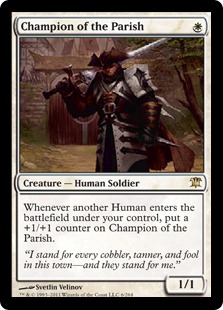
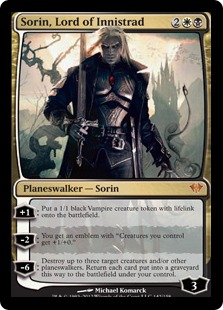
My strategy in the Flash matchup was, as I’ve noted above, radically different, and felt very strong to me. What I sideboarded was once I knew not to expect many copies of Izzet Staticaster was -2 Silverblade Paladin, -2 Skirsdag High Priest, -4 Champion of the Parish, +2 Obzedat, Ghost Council, +2 Sorin, Lord of Innistrad, +2 Lingering Souls, and +2 Tragic Slip. Against Joel Larsson and his full set of Boros Charm and hyperaggression, I would have passed up Sorin to avoid trading with Boros Charm or falling behind since the emblem plan works best when you’re on the attack. In the future, with Gerry Thompson recommending the return of Izzet Staticaster, I would likely run only three Lingering Souls to avoid drawing multiples and have all three Tragic Slip as a response.
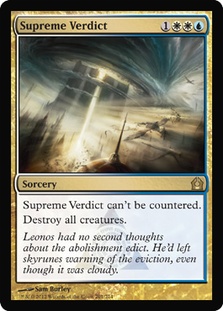
The thinking here is that Flash gets its advantage during the early and middle stages of the game from Supreme Verdict and from using Augur of Bolas and Snapcaster Mage with or without Restoration Angel to pair with removal that trades for my cards (plus perhaps Izzet Staticaster). They’ll also lean on Restoration Angel and Boros Reckoner as good men. Later on, they’ll try to crush me with Sphinx’s Revelation and the overload on Mizzium Mortars, but that takes a while to develop and the first Revelation is usually only for three or four, which will only generate two or three spells. Lands past the first six matter little to them unless they have Revelation again, and they are drawing off cantrips (Azorius Charm counts even when they put a creature on top unless they Thought Scour) and starting with more land than you, plus Vault of the Archangel matters, so you have a natural spell advantage there.
How do they answer an Obzedat, Ghost Council if you can avoid them countering it by getting them to tap out or using a Cavern of Souls? They are hoping to take damage and then trade two cards for it if you can afford to not expose it by attacking. Their permanent answers to Falkenrath Aristocrat are few and far between; either they use Azorius Charm and Thought Scour, they counter it, or they run you out of creatures to sacrifice. Lingering Souls is not a card that they match up well against unless they can stick a Restoration Angel.
Even if they get Supreme Verdict going or Mizzium Mortars on overload, you’ve taken their greatest trump card and allowed it to gain them only moderate advantage since you can usually use Lingering Souls and one other card to force their hand. Sorin, Lord of Innistrad properly timed makes their life very difficult. Meanwhile, they now often have zero or only one Supreme Verdict game 1 and only two or three after sideboarding, so you can play to force the first one and then they probably need to hit six mana to do it again.
The problem with this plan is that if you give them the chance to trade off their cheap spells with your cards, they can get far enough ahead on cards that you can run out of shields for your Falkenrath Aristocrats, let them get enough board presence to take control and even attack, or simply make awkward trades to get your better cards off the board since they’re so far ahead on cards.
Looked at from your side, you can have draws that present threats that are easy to answer and thus not present enough top quality threats to overpower their answers as you run out of waves and haymakers. Ignoring Augur of Bolas and Snapcaster Mage on the board is vital. Meanwhile, your Champion of the Parish are weakened because you can’t profit from Silverblade Paladin, which is one of the best ways to turn Champion into a big game, so often they end up being the world’s worst Doomed Travelers—pure cannon fodder soaking up removal. By taking away that avenue of escape, you still have enough cannon fodder most of the time but avoid exposing yourself with it. Knight of Infamy poses a similar problem but can cut through Boros Reckoner and Augur of Bolas, so if you’re not too worried about Izzet Staticaster then he can stay.
Pulling back from thinking about The Aristocrats, this starts to look eerily familiar to me because I used similar strategies against Flash with both Zombies in Atlantic City and with W/G Humans when I was preparing that deck for Montreal.
For Atlantic City, I’d pulled the bad cannon fodder that had one toughness and not enough power, which was vulnerable to Izzet Staticaster and played too easily into Supreme Verdict, in favor of the more serious threat of Olivia Voldaren that they’d have to answer and removal spells for Restoration Angel and Izzet Staticaster rather than trying to win fast with a frontal assault. Why walk a Hellrider into Restoration Angel town? Trying to win on speed was the game they wanted me to play, whereas Thundermaw Hellkite and Falkenrath Aristocrat were exactly what they didn’t have good answers to. By avoiding giving them easy answers, I took away the option to use awkward trades on my best threats to bridge the gap. Both times I played against Flash their deck seemed awful, and they fell further behind every turn until they died.
With W/G Humans, the thinking was similar. They have a few great cards which could answer entire waves of attackers, with the most important being Supreme Verdict. By playing creatures and using spot removal, they would force a lot of commitment to the board and then punish that with Supreme Verdict, which they could then do again a few turns later. To win, you needed to proceed with waves that put them to a decision and forced them to have it without throwing in so many cards that you couldn’t rebuild. This led to the answer of Faith’s Shield and Riders of Gavony to enhance and protect your waves of attackers.
Gerry refers to Supreme Verdict as training wheels. I understand where that metaphor comes from, but to me it is all wrong. The option (from your perspective) and the threat (from theirs) of Supreme Verdict is what allows the Flash deck to work against smart aggressive decks that don’t get blown out by Augur of Bolas and Snapcaster Mage. You need a way to punish deployment of everything to the board and a source of card advantage that doesn’t rely on them making themselves vulnerable. I find it easy against Flash to force them to Supreme Verdict quickly when I play aggressive decks; the hard part is doing that without losing to Supreme Verdict when they have it. If I played Flash, which I’ve never done, I’d presume that I’d have access to all four. You can also look at this as my not understanding why you’d take the training wheels off.
I am and always have been a big fan of tons of mass removal in my control decks. Wrath early and often so you can always have it, use a second one to mop up their second wave when they think you don’t have it any more, and have more left to use as spot removal without worrying about the consequences. Similarly, I want to have a way to bury my opponents so they don’t go back over the top of me. When The Aristocrats or another aggressive deck tries to assert inevitability through superior threats, the way that fails is if there are huge cards like Angel of Serenity that can come back over the top again and ruin your day.
When I was preparing for Atlantic City and trying to play aggressive Bant, I would often have the issue that I could find cards that killed Bant players but couldn’t both do that and line up against the dreaded Angel of Serenity package (or, very frustratingly, Olivia Voldaren, which can and do fill that role very well) that others would use. Someone was going to trump me no matter what. Yes, Sphinx’s Revelation can be and often is the finishing blow that puts the opponent away when it’s big enough, but the defensive decks have a huge edge in a Revelation war, so if you’re using a different angle you have to turn elsewhere (and even then it takes a long time to be enough).
From this perspective, Naya, Jund, and Flash all present a peculiar puzzle. Even Bant and Esper do some of it, although for them Supreme Verdict and hard counters make up for a lot. All of them have tools to stay alive, and they have tools that are excellent at grinding out players that are trying to kill them before they can deploy their stay alive tools. Against each other and in many matchups, they try to see whose grinding tools can exhaust or get the drop on the other player. They play haymakers against each other to gain incremental advantage, but what’s the Jund mirror breaker? Strangely enough, it’s Staff of Nin because it gives you a steady stream of four to six cost haymakers to keep throwing until the opponent runs out of them. Cards that are more expensive than that get caught in a Rakdos’s Return. It takes two more mana to get something that can’t be answered properly, and eight is too much.
There’s also the problem that if your expensive spells are too expensive to help you stay alive that you will often be dead before you can play them. With so many quick and efficient threats and lots of mana slots in the “midrange” decks, there’s no room to go big. Thus, Gerry Thompson can play a deck that looks like it doesn’t have that much power, but by lining up well against the threats that are out there, it can call itself a control deck; The Aristocrats can functionally sideboard into a weird kind of threat-based control role in places it shouldn’t have that ability.
Zombies would often have the ability to go “both under and over” its opponents after sideboarding, as the late game belonged to Vampire Nighthawk, Olivia Voldaren, Falkenrath Aristocrat, and Thundermaw Hellkite while your one-drops made you the one more likely to knock the enemy out early. Naya, or as we called it “bunch-of-cards.dec,” couldn’t pack enough power while still staying alive since its defensive cards prevented it from turning the tables quickly when we left ourselves vulnerable. Alas, Zombies in its old form is now a step behind, but Jund Aggro is a worthy heir that plays a very similar game. It feels like there is a lot of room for improvement to help Jund Aggro get more of this type of resilience without sacrificing too much early offense.
Human Reanimator is currently the king of playing at the next level of impact, forcing players to pack explicit hate to keep the deck in check. It beats players who are forced to use the defensive card sets and is in deep trouble against offensive ones, which is why its new plan against offensive sets is now transformation into the defensive set.
Offensive strategies now have two paths, and you can choose either or both. You can try to go under the defensive card sets the way Naya Blitz does and abandon the late game. Brad Nelson often conceded playtest games quickly once the first wave was stopped, saying “this is over” often as early as turn 3 or 4. You can try to have resistant threats, like The Aristocrats. Or you can try to do some of both, retaining the early knock out while also having late game. The Aristocrats tries to do this and Tom and Sam push this hard with their play, but as I played the deck I felt like my knockout plan was too weak, whereas WG Humans was much closer to a hybrid approach.
The knockout blow represents what Gerry called the Burning-Tree Emissary pillar of the format. Supreme Verdict is currently the trump knockout blow because people don’t dare play other cards that have that level of impact except for Reanimator, so that forms his second pillar. The third he represents with Thragtusk, which is the avatar of midrange defensive creatures. I think there’s a fourth pillar represented by Falkenrath Aristocrat (the question of what happened to Geist of Saint Traft is another I’m still puzzling over) as the aggressive path that resists being answered rather than trying to win in a blitz. Then, as Gerry noted, there’s Unburial Rites as the fifth path.