

[Editor’s Note – This article was originally posted as a Premium piece on Monday 25th January 2010. We’ve decided to open it up for all to read, as it’s invaluable information to ANYONE looking to enjoy Legacy at any upcoming event. With the StarCityGames.com Legacy Open tournaments coming to a city near you soon, it’s the perfect time to jump into this vibrant Eternal format!]
I have a special treat in store for you today. Today, I will look at every single deck in Legacy. Today, I review over 50 archetypes! I start with the 6 Decks To Beat and the 5 other Decks You Are Likely to Face. Then, I round out the article with over 40 Marginal Players and Rogue Options.
But more than that, I will explain how they work, show you recent SCG stats for each deck, highlight their weaknesses, and describe the buzz about it. With much gratitude to SCG’s Jared Sylva, I can show you the performance statistics for each of these archetypes in both the StarCityGames.com Legacy Open in LA and the StarCityGames.com Legacy Open in Dallas.
So, suppose you are new to Legacy. You’re curious about it, but you don’t know where to begin. You’re not sure how to research the format. There are a lot of funny decknames, unusual cards, and it’s all unfamiliar. This article is for you.
Or you are a Legacy expert, but you’ve been trying to introduce friends to the format, or you’ve wanted a single resource that has all of the decks in one place. This article is for you.
And if you are just a Legacy Expert? Well, I’ve aggregated all of the SCG stats from LA and Dallas into one giant grid, which, along with other tidbits, should be more than enough to satisfy your hunger for Legacy info. Let’s begin!
I. The Decks to Beat / Top Contenders
These decks are the most successful and the most popular decks in Legacy. These decks are the decks you are most likely to face in a tournament, in the swiss or a Top 8.
1) CounterTop


Creatures (13)
Lands (18)
Spells (29)
How It Works:
This is the Counterbalance deck.
Counterbalance and Sensei’s Divining Top is a format defining combo. Counterbalance and Sensei’s Divining Top is one of the most powerful combos in Legacy. Its presence is fundamental to making sense of Legacy. The vast majority of playable spells in Legacy cost 1, 2, or 3 mana. There are two reasons for this. First, because of the format’s card pool is so large, only the most efficient spells ever printed really make the cut and see competitive play. Second, because of the limited amount of excellent acceleration compared to Vintage, more expensive spells aren’t powered out as often. As a result, Counterbalance shapes the very contours of the format. Any deck that clusters around 1 or 2 mana needs answers or risks being marginalized. Other decks respond by increasing their mana costs or avoiding the need to play spells after the first few turns altogether.
This is an Aggro-Control deck that can shift from a control role to a tempo role, and vice versa. Blue cantrips help the deck manipulate both its library and its manabase. Force of Will and Daze help the deck keep control, and protect its combo and its win conditions.
This deck mostly comes in UGW. However, there are a few UGwr or UGwb versions out there. What do they all have in common? All versions of the deck use Tarmogoyf as a powerful beatstick and win condition, so much so that until recently, this archetype was known as CounterTop-Goyf. Some versions run Black, for Dark Confidant. Most run White for spot removal like Swords to Plowshares.
This deck features another powerful combo: Natural Order and Progenitus. Not all CounterTop decks run Progenitus, but most of the recently successful variants on the SCG Open series feature it.
Recent Performance Stats:
6-0 versus Canadian Threshold
4-0 versus Burn
3-0 versus Aggro Loam
5-1 versus Belcher
6-2 versus Ad Nauseam
3-3 versus Zoo
2-2 versus 38 Land
2-2 versus Dream Halls Combo
3-6 versus Goblins
1-3 versus Enchantress
2-7 versus Merfolk
These stats were taken from SCG’s Legacy Open in Los Angeles and Dallas, which I’ve aggregated. These stats represent the results of all of the matches played by CounterTop versus these opponents in those two tournaments, and the results. For example, this archetype went 6-0 against Canadian Threshold in tournament matches played in those two tournaments.
I’ve chosen stats which I think represent the archetype’s strengths and weaknesses. For more stats, see the Matchup Grid I created at the end of this article.
Weaknesses:
As you can see, this deck’s main weakness is Merfolk. Lord of Atlantis gives all of their creatures Islandwalk, and they become unblockable. Also, this deck is weak to Goblins, which bypasses Counterbalance with Aether Vial (just like Merfolk) and Goblin Lackey. Thus, the decks is also weak to Goblins. Its other bad matchup is Enchantress, which overwhelms it and can pretty much ignore Counterbalance. Enchantress may be a more marginal matchup, but one that may be arising with greater frequency since it won the SCG Open in LA. Also, the deck will need sideboard space for the Land matchup, which it is also soft to.
Buzz:
In some ways this deck is the middle of a vortex that is the Legacy metagame. This deck’s magnetic influence has shaped the evolution of the format and continues to do so even though the deck is no longer the most popular archetype in any given tournament. Also, this deck hasn’t won a major event since Grand Prix: Chicago, but it’s incredibly flexible and adaptable, and can be tuned for certain metagames. In that way, it’s incredibly adaptable. If you choose not to play it, at least be familiar with it. You have as good a chance of facing this in a large, diverse field as anything else.
2) Merfolk
Creatures (22)
Lands (20)
Spells (18)
Sideboard
How It Works:
This is the format’s premiere tribal archetype. This deck uses a bunch of Merfolk Lords to pump a small army of Merfolk beyond the ability to stop. At the same time, it uses mana denial tactics like Stifle (sometimes), Wasteland, and Cursecatcher. Countermagic like Daze and Force of Will helps keep control over the game, and protect the best threats. This deck uses Aether Vial to power out uncounterable creatures and evade Counterbalance.
Stats:
9-2 versus Ad Nauseam
7-3 versus Burn
7-2 versus CounterTop (5-0 versus Countertop and 2-2 versus NO CounterTop)
5-3 versus Aggro Loam
5-4 versus Goblins
4-3 versus Survival
4-4 versus Zoo
3-4 versus Stax
2-4 versus Canadian Threshold
2-4 versus Dredge
Weaknesses:
Until very recently, this deck had a terrible record versus Zoo. In fact, Zoo’s success for much of last year is directly attributable to the tremendously lopsided matchup it enjoyed against Merfolk. However, Merfolk pilots have made significant progress with lots of sideboard hate, and have evened the matchup. Even still, that’s only a 50-50 matchup, and that’s with a lot of luck. Zoo dominated Merfolk in a recent Top 8. Also, Imperial Painter, although an unlikely matchup, is nearly unwinnable. Another weak matchup is Canadian Threshold. Finally, Merfolk, despite having Back to Basics, apparently is weak to the Land matchup, although that isn’t reflected in these stats.
Buzz:
This deck is relatively inexpensive to put together, and is always one of the most popular decks in the field. Be prepared because chances are good that you’ll face this. It’s pretty hot.
3) Zoo
Creatures (24)
- 4 Kird Ape
- 4 Grim Lavamancer
- 4 Tarmogoyf
- 1 Gaddock Teeg
- 1 Figure of Destiny
- 4 Wild Nacatl
- 2 Knight of the Reliquary
- 4 Qasali Pridemage
Lands (20)
Spells (16)
How It Works:
This is the modern version of one of the original Magic archetypes, the multi-color Aggro deck known simply as “Zoo.” This deck uses the most beefy one- and two-drops in Eternal Magic, and the most efficient removal and burn spells ever printed to clear the way or finish the opponent off. Tarmogoyf, Qasali Pridemage, and Wild Nacatl are the deck’s primary beatsticks. Burn removes blockers and Plows take out opposing Tarmogoyfs. Pridemage allows Zoo to win Tarmogoyf battles and deal with Counterbalance.
Stats:
7-1 versus Goblins
3-1 versus Burn
4-4 versus Fish
2-2 versus Canadian Threshold
3-3 versus Aggro Loam
3-3 versus CounterTop (3-1 versus NO versions, 0-2 versus non NO versions)
3-4 versus Dredge
1-2 versus 38 Land (would have been 0-3 if not for a game loss in the finals match)
1-3 versus Survival
1-5 versus Belcher
Weaknesses:
Combo decks like Belcher or Ad Nauseam are very difficult matchups to win because of the lack of discard, countermagic, or mana denial. Zoo seeks to interact on the board. Because Zoo isn’t particularly fast, decks like Land or Dredge, which can quickly clog up the ground, are surprisingly difficult. Survival is also very difficult for a similar reason. Survival decks can set up recurring creature defenses, and win before burn can make a tremendous difference.
Buzz:
Zoo isn’t always one of the top 3 or 4 most popular decks, but it’s a proven tournament winner. It’s relatively easy to build and very good. It’s a perennial player in the Legacy metagame.
4) Canadian Threshold
Creatures (10)
Lands (18)
Spells (32)
- 4 Brainstorm
- 4 Lightning Bolt
- 4 Force of Will
- 4 Daze
- 4
- 4 Stifle
- 4 Spell Snare
- 4 Ponder
Sideboard
How It Works:
The format’s original and purest UG Aggro-Control deck. It’s the oldest deck in the format (since it went from 1.5 to Legacy), and the archetype won the first European Legacy Grand Prix. The colors change, but this is the latest (and only enduring) incarnation.
It plays a few key threats, in the form of Tarmogoyf and Nimble Mongoose, and counters (with Force, Daze, or Spell Snare) or burns (with Lightning Bolt and Fire/Ice) whatever you try to do. It gains tempo a combination of mana denial, countermagic, and burn/removal.
Stats:
4-2 versus Merfolk
2-1 versus Enchantress
2-1 versus Ad Nauseam
2-2 versus Zoo
1-1 versus Goblins
1-1 versus Aggro Loam
0-2 versus Stax
0-6 versus CounterTop (0-2 to countertop, and 0-4 to Natural Order Bant)
Weaknesses:
The greatest thing about this deck is that it has no truly bad matchups. It splits with just about everything, and has a few key good matchups. Its weaknesses are mostly tactical. It has no basic lands, so it has problems with effects like Blood Moon and can struggle against Loam decks. That’s the basic idea behind the deck. However, the switch from 4c to far more stable 3c manabases by Countertop pilots has apparently dramatically and rapidly shifted that matchup. In the last two SCG Opens, it appears that Canadian Threshold decks had their greatest difficulty in beating Natural Order CounterTop lists, as they went 0-4 against them, and lost to 0-2 to regular Countertop decklists as well. Unless this changes, Canadian Threshold may go the way of Dreadtill, and become a fringe player in the field.
Buzz:
This deck has lost some luster in the last month or so. It remains to be seen if this deck will return in a bigger way.
5) Aggro Loam
Creatures (13)
Lands (27)
Spells (20)
- 3 Seismic Assault
- 1 Terminate
- 4 Mox Diamond
- 4 Chalice of the Void
- 2 Engineered Explosives
- 4 Life from the Loam
- 2 Maelstrom Pulse
Sideboard
How It Works:
This is the format’s premiere aggressive Life From The Loam deck. It combines a mixture of mid-range creatures, removal, mana denial, and recursive Loam-fueled Seismic Assault kill.
Specifically, the deck deploys Tarmogoyf – like many Legacy decks – and Countryside Crusher as beaters or defensive walls. Dark Confidant and cycle lands + Life From The Loam generates card advantage until the Seismic Assault engine comes online. Maelstrom Pulse and Engineered Explosives are removal.
Earlier builds used Devastating Dreams for more general removal and more discard. It remains to be seen if we will see a revival of those approaches. For the time being, Aggro Loam eschews Duress effects and Devastating Dreams in favor of Chalice of the Voids.
Stats:
5-3 versus Ad Nauseam
3-5 versus Merfolk
3-3 versus Zoo
2-2 versus Belcher
3-2 versus Goblins
0-3 versus Countertop
3-1 versus Enchantress
1-3 versus Dredge
Weaknesses:
The deck has some manabase consistency issues, and is vulnerable to certain anti-graveyard tactics like Extirpate or creature cards like Sower of Temptation. Strategically, the deck is very weak to burn-based strategies. And, according to these stats, Aggro Loam is having difficulty beating CounterTop strategies as well, which may be a function of the small sample.
Buzz:
This deck is pretty hot, and dominated SCG St. Louis. It’s on the upswing, but it’s hard to tell how far up it will go, or whether, like Stax, a one-hit wonder.
6) 38 Land
Lands (38)
Spells (22)
- 4 Exploration
- 2 Intuition
- 1 Crucible of Worlds
- 3 Gamble
- 4 Manabond
- 3 Mox Diamond
- 1 Engineered Explosives
- 4 Life from the Loam
Sideboard
How It Works:
The format’s premiere Control Loam deck. This is a grinding and soul-crushing control deck. It accelerates with Manabond and Exploration, and fills the graveyard up with Life From the Loam and Intuition. It simultaneously clogs up the board with manlands, Maze of Iths, The Tabernacle at Pendrell Vale, and lands like Barbarian Ring. It grinds the game to a halt until it can win with overwhelming forces.
Stats:
2-1 versus Merfolk
2-1 versus Zoo
2-1 versus Canadian Threshold
2-2 versus Ad Nauseam
2-2 versus Dredge
2-2 versus CounterTop
1-2 versus Enchantress
0-1 versus Goblins
0-2
Weaknesses:
Back to Basics and Blood Moon are devastating tactics, as all of your lands either turn into Mountains or become one-time use Lotus Petals. Leyline of the Void is an obstacle to winning as the deck relies so much on Loam.
In my experience, I have found that this deck is weakest to speed combo strategies, but the data does not clearly bear this out. I suspect it’s because the Land deck is packing solid anti-combo measures post-board. However, certain intra-archetype combos, like Natural Order for Progenitus, are game-winning against Land. Land has no way of addressing a Progenitus.
There are two notable weak matchups, and one that is clearly so: Enchantress and Goblins. Fortunately for Land pilots, Goblins is not a very successful archetype as long as Zoo is around, and Enchantress is a very low percentage of the field.
Buzz:
This deck is scorching hot, but good luck getting the Tabernacles to play it. This deck owns both Merfolk and Zoo, one of the few decks that naturally does, which is why it’s so good. This may very well be the best deck in Legacy.
II. Decks You Might Face
The six decks I just reviewed are the best performing decks in the format, and happen to be among the most popular in Legacy. Those are decks that will show up in any Legacy tournament, and are very likely to Top 8. However, there are other decks that happen to be as popular as those decks, but don’t have the same successful track record. I will review those decks now. These are decks you are just as likely to face at the Decks To Beat, but they aren’t as good, at least in terms of recent tournament performance.
7) Dredge
Creatures (28)
- 4 Tireless Tribe
- 4 Putrid Imp
- 4 Ichorid
- 1 Flame-Kin Zealot
- 4 Golgari Grave-Troll
- 2 Golgari Thug
- 4 Stinkweed Imp
- 4 Narcomoeba
- 1 Iona, Shield of Emeria
Lands (12)
Spells (20)
Sideboard
How It Works:
Dredge is a hyper-aggressive, highly linear aggro-combo deck. It aggressively dredges as much of its library as it can as quickly as possible, by discarding Dredgers like Stinkweed Imp and Golgari Grave-Troll to Putrid Imp, Tireless Tribe, Breakthrough, and Careful Study. Then, it puts cards like Bloodghast, Ichorid, and Narcomoeba into play, all of which trigger Bridge From Below when it flashes back Cabal Therapy or Dread Return. Dread Return bringing Flame-Kin Zealot into play only needs 6 Bridge tokens to deal 21 damage.
Stats:
4-4 versus Merfolk
3-1 versus Aggro Loam
4-3 versus Zoo
4-4 versus Ad Nauseam
2-2 versus Belcher
2-2 versus Land
3-4 versus Goblins
Weaknesses:
The struggles to defeat powerful anti-graveyard tactics like Leyline of the Void, Ravenous Trap, Tormod’s Crypt, Relic of Progenitus, and Yixlid Jailer. The more graveyard hate in the metagame, the worse Dredge performs. Also, Enchantress, despite having weaker graveyard hate, poses unique problems for Dredge. Cards like Elephant Grass and Solitary Confinement make it nearly impossible to win.
Buzz:
Zendikar’s Bloodghast has generated quite a bit of buzz around Dredge. Dredge was the most popular deck in St. Louis, but failed to put anyone in the Top 8. It hasn’t made Top 8 in the last SCG Opens. It nonetheless is one of the more popular decks in the field. As people forget about it and decide to gamble by reducing their graveyard hate, Dredge will be poised to strike.
8) Ad Nauseam
Lands (15)
Spells (45)
How It Works:
The format’s Dark Ritual/Tendrils of Agony combo deck. Although there are several major variants on the archetype, the idea is the same: use either Doomsday, Ill-Gotten Gains, or Ad Nauseam to generate the storm and mana to play lethal Tendrils of Agony. Ad Nauseam generates the card advantage and resources to generate storm and mana with Tendrils. The main engine is Ad Nauseam, which, when resolved, generates incredible card advantage. Ill-Gotten Gains allows another kill where you loop Ill-Gotten Gains, reusing Lion’s Eye Diamonds and probably Infernal Tutor to generate enough mana and storm to play a lethal Tendrils. This deck uses cheap Blue cantrips to assemble the key combo, and discard effects, Red Elemental Blasts, and Xantid Swarms to combat countermagic.
Some versions, like the one I’ve shown here, splash Red for Red Elemental Blast and Burning Wish. Burning Wish allows the deck to use a toolbox sideboard, and store more bombs and engine parts in the board.
Stats:
5-0 versus Survival
2-0 versus Enchantress
4-1 versus Burn
3-2 versus Stax
1-1 versus Zoo (generally much better, a small sample size here)
4-4 versus Dredge
2-2 versus 38 Land
3-4 versus Goblins
3-5 versus Aggro Loam
1-2 versus Canadian Threshold
1-2 versus Belcher
2-6 versus CounterTop
2-9 versus Merfolk
Weaknesses:
Ad Nauseam, statistically based on previous SCG results, does not beat Canadian Threshold, Merfolk, or CounterTop strategies. The most recent SCG results seem to confirm these original findings. Its record against Merfolk is abysmal, and Merfolk is one of the most popular strategies in the format. The reason is simple: the mix of mana denial and countermagic is often too much for Ad Nauseam. The quick life loss can also make a difference. Canadian Threshold also packs answers like Stifle.
Tactically, cards like Chalice of the Void are very effective at slowing down Ad Nauseam. This no doubt explains Aggro Loam’s recent success. Countermagic is very effective against these archetypes, which often cannot defeat multiple pieces of countermagic at once. Ad Nauseam pilots will try to play a bunch of lands and resolve an Orim’s Chant and then combo out. If the Orim’s Chant can be stopped, then the subsequent engine spell can be stopped.
A combination of countermagic and discard the most effective counter-measure. Force of Will and Duress is usually this deck’s worst nightmare.
Other cards like Ethersworn Canonist or Rule of Law effects are also very useful, and must be addressed before the ANT pilot can win. Less potent, but still effective, are cards like Sphere of Resistance, Thorn of Amethyst or Mindbreak Trap.
Buzz:
Ad Nauseam is a popular strategy despite dismal results. Dedicated ANT pilots claim the ability to defeat Blue decks, but tournament results do not support these assertions. Still, the flashy combo deck is alluring to certain players who like to win quickly and with pizzazz.
9) Goblins
Creatures (32)
- 3 Mogg Fanatic
- 3 Goblin Matron
- 4 Goblin Lackey
- 4 Goblin Warchief
- 4 Goblin Piledriver
- 3 Gempalm Incinerator
- 3 Siege-Gang Commander
- 4 Goblin Ringleader
- 3 Mogg War Marshal
- 1 Goblin Chieftain
Lands (21)
Spells (7)
How It Works:
The format’s former premiere tribal archetype, it’s the Goblins tribal aggro-combo deck. The deck overwhelms the opponent with tempo and card advantage. Aether Vial, Goblin Lackey, and Goblin Warchief help the deck accelerate out. Goblin Piledriver permits fast, unstoppable victories. Goblin Ringleader draws more Goblins, and Matron tutors for unique answers, card draw, or finishers like Siege-Gang Commander or Kiki-Jiki, Mirror Breaker.
Stats:
1-0 versus 38 Land
3-1 versus Burn
6-3 versus CounterTop
4-3 versus Dredge
4-3 versus Ad Nauseam
4-5 versus Merfolk
2-7 versus Belcher
1-7 versus Zoo
Weaknesses:
There is one thing holding Goblins back. There is only one thing that preventing Goblins from being a Tier 1 deck. Goblins, once a dominant Legacy deck, appeared to be on the verge of a comeback last Summer, after M10, but it was checked by one critical development: the rise of Zoo. According to my Legacy matchup grid from last year, Goblins cannot beat Zoo.
Our results this time confirm this. Its matchup versus Belcher is also very poor, but Belcher is a much smaller portion of the field.
Buzz:
Goblins won the very first American Legacy Grand Prix. Goblins has almost no buzz, but remains a deadly archetype, should the moment arise.
10) Burn
Creatures (12)
Lands (20)
Spells (28)
- 4 Lightning Bolt
- 4 Fireblast
- 4 Chain Lightning
- 4 Price of Progress
- 4 Magma Jet
- 4 Rift Bolt
- 4 Flame Javelin
Sideboard
How It Works:
No explanation needed. The deck fires off as many burn spells as it can, and tries to kill you as quickly as possible.
Stats:
0-5 versus Belcher
1-4 versus Ad Nauseam
1-3 versus Zoo
1-3 versus Goblins
3-7 versus Merfolk
3-7 versus CounterTop
Weaknesses:
Combo, Counterbalance, any form of life gain.
Buzz:
This deck is an ever present part of the field, if only because it’s easy to assemble. Even then, some folks believe that burn present a formidable metagame choice. There is little empirical evidence in support of such a contention, but it nonetheless persists.
11) Belcher
Spells (46)
- 4 Dark Ritual
- 4 Land Grant
- 4 Desperate Ritual
- 4 Burning Wish
- 4 Goblin Charbelcher
- 4 Seething Song
- 4 Lotus Petal
- 4 Lion's Eye Diamond
- 4 Chrome Mox
- 4 Rite of Flame
- 3 Empty the Warrens
- 3 Manamorphose
Sideboard
How It Works:
This is one of the original Legacy combo decks. It uses virtually all of the format’s viable mana acceleration to play turn one or turn two Goblin Charbelcher, and activate it. Lion’s Eye Diamond will often pay for the activation. Because the deck has only 1-2 lands, Goblin Charbelcher will often win the game on the first activation.
Stats:
5-0 versus Burn
5-1 versus Zoo
2-1 versus Merfolk
2-7 versus Goblins
1-5 versus CounterTop
Weaknesses:
It’s the most relentlessly linear deck in Legacy besides Burn. As a consequence of both its speed and its single-mindedness, it is vulnerable to fast countermagic, inconsistency, and certain sideboard cards like Pithing Needle, Mindbreak Trap, and Chalice of the Void.
Buzz:
That said, the deck is a lot of fun to play. Killing your opponent round after round on turn 1 may be tiring for opponents, but it results in a memorable experience. Cedric Phillips made Top 8 at one of the SCG Opens with it, and others have come close to repeating the feat.
III. Marginal Players
The six Decks To Beat and the five other Decks You Might Face should constitute your gauntlet. But that’s far from the sum total of options you have in Legacy. Next, I will review the decks that tend to show up in most large scale Legacy tournaments, but in tiny numbers. These decks will be present at whatever Legacy event you attend, but you are not very likely to face them. Nonetheless, you should be familiar with them in case you do.
12) Enchantress
Creatures (4)
Lands (20)
Spells (36)
How It Works:
This is the synergistic enchantment deck, or the Replenish deck, depending on your perspective. First, the deck develops using cheap mana enchantments like Wild Growth and Utopia Sprawl. Then, it builds a tremendous wall of enchantments to protect itself from any manner of attack, using cards like Elephant Grass, Moat, and Solitary Confinement. It generates card advantage through Enchantress effects, and eventually combos out using Serra Sanctum and Words of War or Sigil. If any spells are countered, it will recur them with Replenish. Opponents have difficulty countering spells with City of Solitude in play. Also, Sterling Grove serves both as protection for its enchantments and as a tutor for strategic consistency.
13) Mono White Stax
Creatures (5)
Lands (25)
Spells (30)
How It Works:
The format’s premiere artifact deck. It combines the format’s best mana acceleration with Mox Diamond, Ancient Tomb and City of Traitors to power out artifact lock parts like Smokestack, Crucible of Worlds, Chalice of the Void, and Trinisphere. Crucible of Worlds supports both Smokestack and Wasteland recursion to annihilate the opponent’s manabase. In addition to Wasteland and Crucible, the deck attacks the opponent’s manabase with Armageddon. It prevents the creature rush by playing spells like Ghostly Prison and Magus of the Tabernacle. The most recent addition has been Baneslayer as a finisher.
14) Survival
Creatures (21)
- 4 Birds of Paradise
- 1 Genesis
- 1 Anger
- 3 Eternal Witness
- 1 Squee, Goblin Nabob
- 1 Big Game Hunter
- 4 Tarmogoyf
- 2 Shriekmaw
- 2 Kitchen Finks
- 2 Qasali Pridemage
Lands (21)
Spells (18)
- 1 Sensei's Divining Top
- 2 Mirri's Guile
- 4 Swords to Plowshares
- 4 Cabal Therapy
- 4 Survival of the Fittest
- 3 Thoughtseize
Sideboard
How It Works:
The deck is built around Survival of the Fittest. It uses Survival to set up a tremendous card advantage engine, which, first, finds Squee Goblin Nabob as an additional card to pitch to Survival every turn. Then, Anger and Genesis are put into the graveyard to speed up your kill and recur creatures that die or cards like Shriekmaw. Eventually, you win with Tarmogoyf. Thought seize and Cabal Therapy also help you interact with Blue decks and combo decks. There are a tremendous number of options with Survival, and Survival is one of the most powerful engine cards legal in Legacy.
15) B/G Suicide (a.k.a. Eva Green)
Creatures (17)
Lands (22)
Spells (21)
- 1 Umezawa's Jitte
- 4 Hymn to Tourach
- 1 Duress
- 1 Diabolic Edict
- 4 Dark Ritual
- 4 Sinkhole
- 2 Snuff Out
- 4 Thoughtseize
Sideboard
How It Works:
This is the modern, most successful variant of old school Suicide Black, which can no longer resist Green to splash for Tarmogoyf. It features the usual suspects: Hymn to Tourach and Sinkhole as disruption; Nantuko Shade and Hypnotic Specter as beaters. This deck uses the format’s oldest mana and hand disruption, coupled with fast beaters, an efficient draw engine, and some spot removal. This deck is capable of winning any match.
16) WGB (a.k.a. PT Junk)
Creatures (26)
- 4 Mother of Runes
- 4 Dark Confidant
- 4 Serra Avenger
- 4 Tarmogoyf
- 2 Doran, the Siege Tower
- 4 Qasali Pridemage
- 4 Putrid Leech
Lands (20)
Spells (14)
Sideboard
How It Works:
Formerly known as PT Junk, it’s one of the format’s most powerful mid-range decks. It features the absolute best beaters in three colors for a combination of tactical advantages and tempo. It has disruption and removal and multiple sources of card advantage. This deck can pump out a steady stream of beaters (like Putrid Leech and Serra Avenger), while addressing opponent’s threats. There are multiple sources of card advantage, like Life From the Loam and Dark Confidant. This is a powerful option for any Legacy player.
17) Affinity
Creatures (28)
- 4 Arcbound Ravager
- 4 Arcbound Worker
- 3 Myr Enforcer
- 4 Frogmite
- 4 Disciple of the Vault
- 4 Ornithopter
- 1 Ethersworn Canonist
- 4 Master of Etherium
Lands (18)
Spells (14)
How It Works:
This once greatly feared Standard deck continues to show up in Legacy tournaments. It is a speedy Aggro deck built around the monstrous power of Arcbound Ravager. The deck works basically like this: dump a bunch of artifacts onto the table and begin attacking either with: 1) Cranial Plating equipped creatures, 2) Master of Etherium, or 3) Arcbound Ravager. Sometimes Affinity pilots use Fling or Berserk to finish the job. Thoughtcast helps generate card advantage. Disciple of the Vault helps you win the game if the ground stalls.
18) Landstill
Creatures (1)
Planeswalkers (2)
Lands (24)
Spells (33)
How It Works:
This is one of the format’s most famous control decks. It uses Standstill as a draw engine and manlands like Mishra’s Factory as both defense and eventual win conditions. This deck repeatedly clears the table with Wrath of God effects and targerted removal, and protects its spells with countermagic. The deck also features recursive answers such as Engineered Explosives with Academy Ruins, and Crucible of Worlds with Wasteland and Mishra’s Factory. Some versions, like this one, also run Planeswalkers for additional utility and other bonuses. The deck comes in several variants. The most popular version is UWb, although UWg or Uwbg versions sometimes appear.
19) UGb Tempo (a.k.a. Team America)
Creatures (8)
Lands (20)
Spells (32)
- 4 Brainstorm
- 4 Force of Will
- 1 Reanimate
- 1 Smother
- 4 Daze
- 4 Stifle
- 3 Snuff Out
- 4 Ponder
- 4 Thoughtseize
- 3 Spell Pierce
Sideboard
This is the Black splash UG tempo deck. Instead of relying on Nimble Mongoose, however, this deck pairs Tombstalker with Tarmogoyf, for maximum impact. Also, in addition to the tempo plays of Daze, Force, Stifle, and, in this case, Spell Pierce, Team America also runs discard like Thoughtsieze and sometimes Hymn to Tourach. Older versions use Sinkhole for tempo as well. This is, like Canadian Threshold, a hyper-tempo deck, but in different colors. The deck plays out using its countermagic to stop anything relevant and attack with Goyf and Tombstalker as aggressively as it can.
20) Dragon Stompy
Creatures (24)
- 4 Arc-Slogger
- 4 Rakdos Pit Dragon
- 2 Akroma, Angel of Fury
- 4 Simian Spirit Guide
- 4 Gathan Raiders
- 4 Magus of the Moon
- 2 Taurean Mauler
Lands (18)
Spells (18)
Sideboard
How It Works:
This deck is built around accelerating with Ancient Tomb and City of Traitors. The deck powers out mid-sized red monsters and artifacts like Chalice of the Void and Trinisphere. The deck also disrupts the opponent with Blood Moon and Magus of the Moon. Some versions, like this one, use Seething Song and Akroma for extra late game beef. This deck can be a nightmare for a Counterbalance deck because the spells cost 3, 4, and 5 mana, and because of the speedy Blood Moon effects.
21) Dreadtill
Creatures (6)
Lands (22)
Spells (32)
How It Works:
This the Stifle + Phyrexian Dreadnaught combo deck. The idea is to Stifle Phyrexian Dreadnaught’s Comes Into Play ability to generate a one-mana 12/12 creature. Also, this deck uses Standstill and Counterbalance for card advantage. Both cards work particularly well with the backup win condition of Mishra’s Factory. This deck also features maximum blue disruption and even some mana denial with Wasteland.
22) Elves!
Creatures (36)
- 4 Llanowar Elves
- 4 Wirewood Symbiote
- 4 Quirion Ranger
- 4 Fyndhorn Elves
- 1 Eternal Witness
- 1 Viridian Shaman
- 4 Birchlore Rangers
- 1 Elvish Spirit Guide
- 4 Heritage Druid
- 4 Nettle Sentinel
- 1 Regal Force
- 4 Elvish Visionary
Lands (15)
- 15 Forest
Spells (9)
Sideboard
How It Works:
Another Legacy combo deck. The deck generates infinite mana with the combo of Nettle Sentinel, Heritage Druid, and one other Elf. Every time it plays another Elf, it gets to reuse Nettle Sentinel. With Glimpse of Nature having been played that turn, this can turn into a never ending stream of Elves until you’ve found multiple Nettle Sentinels. Soon, you’ll have the storm and mana to play a lethal Grapeshot. The Red mana comes from Birchlore Rangers. This deck can win as early as turn two with the sequence of Turn 1:
Forest, Mana Elf (Llanowar Elf/Fyndhorn Elf) or Quirion Ranger
Turn 2:
Forest, Nettle Sentinel and Heritage Druid.
Tap all three Elves for three mana.
Play Glimpse of Nature. Play another elf, and untap Nettle Sentinel and draw a card. Play another Elf and draw another card. At this point, you should be able to tap three Elves to generate 3 mana again, and continue the process, drawing more cards and so on.
23) Dream Halls
Creatures (5)
Lands (17)
Spells (38)
One of Legacy’s many Combo decks, built around Conflux and Dream Halls. Doug Linn gave a great explanation how this deck works last week.
24) Imperial Painter
Creatures (22)
- 4 Imperial Recruiter
- 2 Jaya Ballard, Task Mage
- 4 Simian Spirit Guide
- 4 Magus of the Moon
- 4 Painter's Servant
- 1 Vexing Shusher
- 3 Figure of Destiny
Lands (19)
Spells (19)
How It Works:
This is another Legacy combo deck. It uses the combo of Painter’s Servant and Grindstone to mill your opponent’s entire library. Red Elemental Blasts and Pyroblasts are used as support, and become Vindicate counterspells when Painter’s Servant is in play. Imperial Recruiter helps the deck tutor up Painter’s Servant, for consistency.
Here’s an interesting variant on the combo:
Creatures (9)
Lands (22)
Spells (29)
Jason has included the CounterTop combo in this particular variant for additional protection and disruption.
25) White Weenie
Creatures (22)
- 4 Mother of Runes
- 4 Samurai of the Pale Curtain
- 3 Soltari Priest
- 4 Silver Knight
- 3 Jotun Grunt
- 4 Serra Avenger
Lands (20)
Spells (19)
How It Works:
Classic White Weenie: drop a bunch of White creatures onto the table and then Armageddon. Aether Vial helps the deck continue to fill the board with men. Mother of Ruins helps win combat battles, and allows some of the men to win through a strong defense. Oblivion Ring and Swords are targeted removal, and Harm’s Way is a very powerful tactic.
26) B/G Rock
Creatures (2)
Planeswalkers (1)
Lands (25)
Spells (32)
How It Works:
The Black and Green Control deck. It uses Pernicious Deed to wipe the board and keep control. Damnation is the analog here to White’s Wrath. Hand denial substitutes for the lack of countermagic. It uses spot removal in the form of Maelstrom Pulse, Edicts, Pacts, and Innocent Blood to clean up.
27) Reanimator
Creatures (6)
- 1 Akroma, Angel of Wrath
- 1 Empyrial Archangel
- 1 Inkwell Leviathan
- 1 Sphinx of the Steel Wind
- 2 Iona, Shield of Emeria
Lands (16)
Spells (38)
How It Works:
One of the oldest archetypes in Magic, it reanimates monsters with cards like Animate Dead and Reanimate. The monsters are mostly new, like Iona and Inkwell Leviathan. The deck deposits these creatures into the graveyard with Intuition and Entomb.
28) Entomb Hulk
Creatures (6)
Lands (18)
Spells (36)
How It Works:
This is an Innovator innovation. As Patrick Says:
“This is an update of my Entomb-Hulk, a deck I first discussed when Entomb was first unbanned in Legacy. I’ve been talking with Doug Linn and the rest of the Meandeck guys, and I think that this has the potential to be one of the strongest archetypes in the format. On raw power, it is rivaled by few, with the major downside being the prevalence (at times) of graveyard hate in the format.”
The kill is the same as the old Flash deck. In case you don’t remember, read Doug Linn explanation here.
29) Planeswalker Control
Planeswalkers (5)
Lands (23)
Spells (32)
A crushing control alternative to Landstill. This deck started showing up last year. Instead of winning with manlands, it wins with Planeswalkers, which serve as utility, card draw, defense, and other functions besides. It packs even more countermagic than most decks, and is one of the very few Legacy decks to use the Ancestral Visions draw engine. It’s notable for that reason alone.
IV. Dark Horses and other Rogue Options
The options we just reviewed are options that tend to appear in most tournaments, even if only one pilot is playing them. The decks I’m about to review are decks that exist in Legacy, but are as likely not to show up in a tournament as they are to see play. Nonetheless, they have appeared at one point or another, and are options and archetypes you should at least be aware of if you want a full understanding of Legacy.
30) Aluren
Creatures (16)
- 1 Man-o'-War
- 1 Spike Feeder
- 2 Eternal Witness
- 1 Etched Oracle
- 4 Imperial Recruiter
- 4 Wall of Roots
- 1 Ghitu Slinger
- 1 Cavern Harpy
- 1 Dream Stalker
Lands (22)
Spells (22)
Sideboard
How It Works:
The combo works like this: resolve Aluren. Play Imperial Recruiter for Dream Stalker. Play it, returning Imperial Recruiter to hand. Replay Imperial Recruiter, this time tutor up Cavern Harpy. Now, you can combine Cavern Harpy, Dream Stalker, and Imperial Recruiter to gain infinite life with Spike Feeder and deal infinite damage with Ghitu Slinger.
31) Counterslivers
Creatures (19)
Lands (18)
Spells (23)
Sideboard
How It Works:
Known in the Legacy community as “Meathooks,” Counterslivers remain one of the most synergistic tribal decks in Legacy. They are fast, disruptive, and difficult to stop. Aether Vial is a recurring Black Lotus for Slivers. Since virtually every Sliver costs 2, it makes your slivers free and uncounterable, putting out one a turn. A Sinew Sliver with a Muscle Sliver makes each Sliver 4/4 power. These guys can go toe-to-toe with a Goyf. Add a Mutavault into the equation and you have a small army, or at least a mean gang under your control. Crystalline Sliver and Hibernation Sliver make it very difficult for opponent’s to do anything about them. Winged Sliver is just the icing on the cake, which evades a Moat and ground pounders like Goyf. One problem with Slivers, however, is the fact that they all die to Engineered Explosives set at 2.
32) High Tide Combo
Lands (19)
Spells (41)
Spells (40)
- 4 Brainstorm
- 4 Force of Will
- 4 Meditate
- 3 Cunning Wish
- 1 Brain Freeze
- 3 Merchant Scroll
- 3 Turnabout
- 4 High Tide
- 4 Snap
- 2 Flash of Insight
- 4 Ideas Unbound
- 4 Ponder
Sideboard
How It Works:
There are two main variants to this combo deck, which is built around Fallen Empires’ High Tide. The first is frequently known as “Solidarity,” and it uses Reset to generate a critical mass of mana. Once the deck hits its fourth land drop, it plays Reset on the next upkeep and combos out. It plays High Tide, and then Reset and then Meditates until it has a critical mass of spells, and it combos out with Brain Freeze.
The Spring Tide variant is built around Cloud of Faeries, Snap, and Ideas Unbound. The deck basically plays: Turn 3: High Tide, Cloud of Faeries, untap both islands, and tap them for UUUU. Play Ideas Unbound. Play Snap on Cloud of Faeries, untapping the two Islands. Play another draw spell, replay Cloud of Faeries, and so on. Continue doing this until you can win with a lethal Brain Freeze.
33) Sea Stompy
Creatures (19)
Lands (24)
Spells (17)
How It Works:
This is the Blue version of Dragon Stompy. Instead of powering out Dragons, it powers out the uber-expensive Sea Drake for a speedy kill. Mulldrifter draws cards, Sower steals opposing creatures, and Trinket Mage creates card advantage. This deck can drop a turn 1 Sea Drake with Ancient Tomb/City of Traitors and Mox Diamond. Sword of Fire and Ice is a thorough beating.
34) CounterTop Control (It’s the Fear)
Creatures (6)
Lands (20)
Spells (34)
- 4 Sensei's Divining Top
- 4 Brainstorm
- 2 Counterspell
- 4 Force of Will
- 4 Swords to Plowshares
- 4 Island
- 2 Intuition
- 1 Vedalken Shackles
- 2 Engineered Explosives
- 1 Life from the Loam
- 2 Spell Snare
- 4 Counterbalance
Sideboard
How It Works:
This CounterTop variant is more a control deck than an Aggro-Control or tempo deck. It also uses Life From the Loam and Intuition to help get its engine online.
35) Scepter Chant
Planeswalkers (3)
Lands (22)
Spells (35)
How It Works:
This deck is built around the combo of Isochron Scepter + Orim’s Chant. Until it can assemble that combo, it clears the board with typical Blue and White control elements: Wrath of God, Counterspell, etc.
36) Pox
Spells (32)
- 4 Diabolic Edict
- 4 Dark Ritual
- 3 Rain of Tears
- 4 Nether Void
- 4 Sphere of Resistance
- 4 Sinkhole
- 4 Pox
- 1 Icequake
- 4 Chrome Mox
Sideboard
How It Works:
This is a highly disruptive Dark Ritual land destruction/control deck, built around Pox. The deck accelerates with Chrome Mox and Pox, and then casts Pox to clear the board, kill creatures, and knock out the opponent’s mana. It also plays Sinkhole, Icequakes and Rain of Tears for additional land destruction. The deck wins by attacking with Mishra’s Factory or Nantuko Shade. If Nether Void resolves, you are probably not going to win. Wasteland and Rishadan Port also keep opponents at bay, just a hair away from being able to break the lock.
37) Iggy Pop
Lands (15)
Spells (45)
- 3 Tendrils of Agony
- 4 Brainstorm
- 4 Cabal Ritual
- 4 Mystical Tutor
- 1 Island
- 4 Dark Ritual
- 4 Intuition
- 4 Ill-Gotten Gains
- 4 Lotus Petal
- 4 Lion's Eye Diamond
- 4 Leyline of the Void
- 4 Infernal Tutor
- 1 Empty the Warrens
Sideboard
How It Works:
This is a Dark Ritual combo variant, built around the recursion engine of Ill-Gotten Gains. What differentiates this deck from other Dark Ritual Tendrils decks is Leyline of the Void. With Leyline in play, Ill-Gotten Gains is a four-mana Mind Twist. The deck can play Infernal Tutor, and respond by sacrificing Lion’s Eye Diamonds, to find Ill-Gotten Gains. From there, it recurs the LEDs and the Infernal Tutor, and plays Infernal Tutor for another Ill-Gotten Gains. On the next cycle, it tutors up Tendrils of Agony instead of another Ill-Gotten Gains.
38) Black Weenie
Creatures (16)
Lands (22)
Spells (22)
- 2 Umezawa's Jitte
- 4 Hymn to Tourach
- 3 Duress
- 2 Diabolic Edict
- 3 Smother
- 4 Sinkhole
- 2 Slaughter Pact
- 2 Thoughtseize
Sideboard
How It Works:
Modernized Suicide Black, the Mono Black Aggro deck. The disruption is much the same: Sinkhole, Hymn to Tourach, Duress. The creatures are different: Bloodghast, Dark Confidant, and Tombstalker.
39) W/B Suicide
Creatures (18)
Lands (22)
Spells (20)
How It Works:
The White splash Suicide Black deck. Chris Pikula got second place with this archetype at the first American Legacy Grand Prix in 2005. The White splash gives you access to the best removal in Swords and Vindicate, and additional disruption in Tidehollow Sculler. The Green splash remains the most popular version of the deck, but this is a variant that shows up from time to time.
40) Cephalid Breakfast
Creatures (18)
- 4 Nomads en-Kor
- 1 Stern Proctor
- 1 Sutured Ghoul
- 4 Cephalid Illusionist
- 4 Simian Spirit Guide
- 3 Narcomoeba
- 1 Lord of Extinction
Lands (13)
Spells (29)
How It Works:
Cephalid Illusionist and Nomads En-Kor combo to empty the library. From there, Narcomoebas feed Dread Return on a lethal Sutured Ghoul, hasted with Dragon’s Breath. This is a hyper fast Reanimator variant that many Extended players will be familiar with. It rarely shows up in Legacy, but it’s fun to watch when it does.
41) Life Combo
Creatures (20)
- 1 Mother of Runes
- 4 Task Force
- 4 Shaman en-Kor
- 3 Daru Spiritualist
- 3 Nomads en-Kor
- 3 Meddling Mage
- 1 Harmonic Sliver
- 1 Doran, the Siege Tower
Lands (26)
Spells (14)
How It Works:
The infinite life combo deck. Repeated activation of Nomads En-Kor ability with Daru Spiritualist creates infinite toughness. Diamond Valley or Starlit Sanctum can then be activated to gain that amount of life. From there, the pilot hopes to elicit a scoop, since 99% of opponents will be unable to win except by decking.
42) Survival Bant
Creatures (16)
- 1 Wonder
- 1 Squee, Goblin Nabob
- 4 Tarmogoyf
- 1 Rafiq of the Many
- 4 Rhox War Monk
- 4 Noble Hierarch
- 1 Qasali Pridemage
Lands (20)
Spells (24)
How It Works:
This is a very unique hybrid deck designed by Eric Blegen. It is, at core, a CounterTop Goyf deck, but it also uses Survival of the Fittest as a tookbox, alternative combo. Squee and Wonder creates card advantage and evasion.
43) Ninjas!
Creatures (24)
- 4 Ninja of the Deep Hours
- 4 Mistblade Shinobi
- 4 Cloud of Faeries
- 4 Ornithopter
- 4 Spellstutter Sprite
- 4 Zephyr Sprite
Lands (19)
Spells (18)
Sideboard
How It Works:
Another Blue aggro-control deck with Force of Will, Daze, and Standstill. The difference is that this one is built around the ninjitsu mechanic. Ornithopter allows the deck to create tempo advantage by Ninjitsuing in higher-costed creatures.
44) Survival Elves
Creatures (34)
- 4 Llanowar Elves
- 4 Priest of Titania
- 4 Elvish Champion
- 2 Quirion Ranger
- 3 Fyndhorn Elves
- 1 Anger
- 1 Viridian Zealot
- 4 Elvish Spirit Guide
- 1 Squee, Goblin Nabob
- 1 Thornweald Archer
- 4 Imperious Perfect
- 4 Wren's Run Vanquisher
- 1 Progenitus
Lands (18)
Spells (8)
Sideboard
How It Works:
This deck is built around two combos: first, Survival of the Fittest to generate card advantage, recursion capabilities and overwhelming forces. Second, it uses Natural Order and Progenitus as a backup combo. The rest of the deck is Elves that accelerate and boost each other. This is an option for the Jamie Wakefield Legacy player.
45) Faeries
Creatures (19)
- 4 Dark Confidant
- 2 Mistbind Clique
- 4 Scion of Oona
- 2 Sower of Temptation
- 4 Spellstutter Sprite
- 3 Vendilion Clique
Lands (19)
Spells (21)
How It Works:
It’s a standard port into Legacy, and one that uses the more powerful Blue disruption of Force of Will, draw engine of Standstill, and acceleration of Aether Vial.
46) Hexmage Depths
Creatures (11)
Lands (24)
Spells (25)
How It Works:
Vampire Hexmage removes all of the counters off of Dark Depths, generating a 20/20 indestructible flying monster. The rest of the deck is designed to protect and support this combo.
47) Gifts Control
Creatures (8)
Lands (25)
Spells (27)
How It Works:
I have no idea. Read Doug Linn article where he explains the archetype:
48) Mono White Control
Creatures (5)
Lands (23)
Spells (33)
How It Works:
This is the “Parfait” deck of Legacy, the mind-numbing mono-white control deck that uses Enlightened Tutor as a toolbox answer, and wins with a Painter’s Servant combo kill.
49) Bant
Creatures (15)
Lands (19)
Spells (26)
How It Works:
A few pros played this deck at the latest SCG Open. It’s the UGW version of Canadian
Threshold (UGr) or Team America (UGb). It uses Stifle and Wasteland for tempo,
Force and Daze for control, and a few key creatures: Goyf, Hierarch, and Pridemage, along with Vendilion Clique. As you can see, it takes good advantage of Exalted. This is a rogue deck at the moment, but it could easily leapfrog to another category altogether in the near future.
50) U/W Tempo
Creatures (20)
- 4 Mother of Runes
- 4 Weathered Wayfarer
- 2 Jotun Grunt
- 4 Fathom Seer
- 4 Serra Avenger
- 2 Knight of the White Orchid
Lands (17)
Spells (23)
How It Works:
Because of Goyf, practically every Blue-based tempo deck is built around UG. We’ve seen UGr, UGb, and now Ugw variants on the tempo deck. We’ve seen UGW decks that combine tempo and control elements, and variants of those archetypes. But, what we haven’t seen is a version that eschews Green and Goyf, until now. This deck cuts Green, and uses a bunch of creatures that provide card advantage to compensate, like Fathom Seer, Weathered Wayfarer, and Knight of the White Orchid. In some ways, this is like a Grow deck. It relies on a very, very light manabase and is packed with powerful spells. This is also a recent innovation, and is one to watch.
And that concludes our review of Legacy… almost…
51) The Pitch Deck
Creatures (24)
Lands (4)
Spells (32)
- 4 Blazing Shoal
- 4 Pyrokinesis
- 4 Cave-In
- 4 Force of Will
- 4 Unmask
- 4 Coalition Victory
- 4 Misdirection
- 4 Soul Spike
Sideboard
How It Works:
This deck is hilarious. That’s right. Click those links to read this card. This deck wins with either Nether Spirit or Vine Dryad getting a huge boost with Blazing Shoal. Bayson won three matches and drew once in seven matches, and was undoubtedly having the time of his life!
V. CONCLUSION
Legacy is a deep format, with a ton of viable decks, few decks that constitute even more than 10% of any given field, and a bunch of fascinating interactions. Seventeen years of printings have made possible a ton of combination approaches: Natural Order + Progenitus, Phyrexian Dreadnaught + Stifle, Entomb + Reanimate, Dream Halls + Conflux, Painter’s Servant + Grindstone, Dark Depths + Vampire Hexmage, Thopter Foundry + Sword of the Meek, Helm of Obedience + Leyline of the Void, Nettle Sentinel and Heritage Druid, Cephalid Illusionist + Nomads En-Kor + (Narcomoeba, Dread Return, etc), Daru Spiritualist + Nomads En-Kor + Diamond Valley, Ad Nauseam + Tendrils of Agony, Aluren + (Imperial Recruiter + Cavern Harpy + Dream Stalker), High Tide + Reset.
Then, there are the more innocuous combos like Isochron Scepter + Orim’s Chant, Counterbalance + Sensei’s Divining Top, Manabond + Life From the Loam, Mishra’s Factory/Aether Vial + Standstill, Survival of the Fittest and a whole toolbox, and the like.
In spite of all of that, the format is constantly evolving, highly sensitive to new printings, resists attempts to break it, and is amazingly adaptable to new innovations. There is a reason that, aside from reversing power-level errata or reintroduction of older sets, nothing has needed banning in Legacy for 5 years. It is very difficult for anything in Legacy to truly dominate, both because of the variety of decks in the format and the range of tactical responses. It’s difficult to break a format where the most common cards are Force of Will, Daze, and Wasteland. There is a reason combo decks have failed so miserably, in general. It’s difficult to sustain fast creature rushes, unaided, when Tarmogoyfs are in 40-50% of decks in the field. The only thing that dominates Legacy is specific tactics, cards like Tarmogoyf, Force of Will, Wasteland, Daze, Aether Vial, and the like.
The format, even more than those tactics, is defined by the 10 dual lands and fetchlands. These cards are the building blocks of the format. As a result, every imaginable color combination is possible, and the decks I’ve just presented illustrates this.
However, just as it is important to understand all of this, it is important to understand what the current structure of Legacy looks like. By now you have a sense of it, but I want to illustrate it for you. The Matchup Grid contains data from almost every match played in the last two SCG Legacy Opens, from LA and Dallas.
I would suggest that two loops form the core of Legacy:
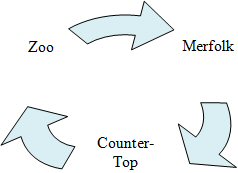
From the data, Zoo appears to push against CounterTop and Merfolk, although experience suggests that it actually be slightly unfavorable to CounterTop and slightly favorable against Merfolk.
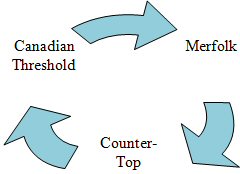
From that perspective, the Merfolk CounterTop matchup organizes the field. Using that dyad, and based upon the Matchup Grid, here is Legacy’s basic structure:
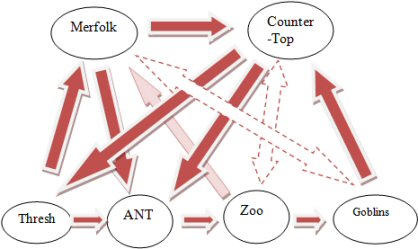
Obviously, things are a little bit more complicated than even this, but from here you can begin to get a sense of what Legacy really looks like, and why the field is so generally a balanced. It’s a network of forces and counterforces. Decks like 38 Land are very well positioned against this backdrop. Their weakest matchups are kept in check, and their strongest matchups have the greatest number of outward arrows.
This is yet another reason that Legacy is so well balanced and difficult to break. It’s a crowded field. It’s rare that a deck makes up more than 15% of the field. As a result, any given deck entering the format will have to face a wide variety of strategies, many of whom they will be favorable against, and others whom they will not. There is no deck, nor even strategic approach, that does not have some weakness in this metagame structure. Graveyard decks face graveyard hate. Combo decks face combo hate and a lot of countermagic. Speed decks face combo decks. Blue control decks face aggro-control decks, which face slightly more aggressive aggro-control decks and tempo decks. Fast aggro decks face slower, but slightly stronger, aggro decks.
The evolution of the format seems to occur within these tight strictures as one archetype or another works hard to soften these arrows, as Merfolk has done with Zoo or as Goblins has done with Ad Nauseam combo. New printings have the potential to power up one archetype or another or create new archetypes, and in the process these printings have the power to transform this structure by redefining these relationships. Worldwake has that potential. Whether it will redefine these relationships, restructure the format, even in modest ways, or create new archetypes remains to be seen.
This is Legacy at the cusp of Worldwake. I hope you’ve enjoyed this article.
Until next time…