
I wasn’t planning on writing this article, but Zac Hill made me…
Standard is kind of a crazy right now. It’s actually been crazy since the end of last year. Why?
Because for the last year, Standard has actually been dominated by Midrange decks.
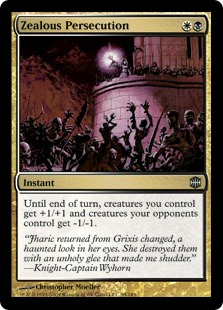
The big two on this? Previous to Alara Reborn, I explored what data we had for Standard, with Midrange King, Brian “BK” Kowal creation, Boat Brew clearly on the top of the field at Kyoto and the StarCityGames.com Indy $5k, with Black/White Tokens also a huge player in both metagames. A quick look at the PTQ season thus far shows that the order of things has changed, certainly, but that it is still Midrange on top, with Black/White Tokens now the abundantly clear deck to beat, with Zealous Persecution finally pushing the deck well over the top of its former rivals.
Midrange’s success has got to be heartening to old-school players like Brian Kowal and Jamie Wakefield, who largely defined their deckbuilding on the back of this kind of deck. Kowal, especially, is well known for forays here, with Ponza, “This Girl” Angel decks, Slideless Slide in Onslaught Block, and Boat Brew. The breakdown, so far, looks something like this:
(1=1st; 2=2nd; 3=3rd/4th; 5=5th-8th; If we use a weighted scoring system, 1 becomes 5 points, 2 becomes 4, 3 becomes 3, and 5 becomes 2)
B/W Tokens: 11223355 (28 points)
White Weenie/X: 5555 (8 points)
G/W Overrun: 335 (8 points)
Bant Aggro-Control: 1 (5 points)
Five-Color Control: 55 (4 points)
Jund Ramp: 2 (4 points)
Esper-Lark: 3 (3 points)
Boat Brew: 3 (3 points)
U/W Lark: 5 (2 points)
B/G Elves: 5 (2 points)
Sanity Grinding: 5 (2 points)
For so many people, accustomed to hating on Midrange as they are, conceiving of the metagame of the last six-plus months as being Midrange-dominated is so impossible, they almost step all over themselves to cast clear midrange decks as not Midrange. For many this antipathy is simple: Midrange decks tend to be bad. But just because it is easy to make a bad Midrange deck does not mean that a Midrange itself is bad.
Misdefining the archetype
One of the common flaws in people’s logic about Midrange decks, as a strategic archetype, is that they conflate sucky traits of decks happen to be midrange with midrange itself. There are a number of common arguments (some of which I’ve gone into before):
– Midrange has no focus.
– Midrange tries to beat everything, so beats nothing.
– Midrange doesn’t do anything.
Yes, if you define Midrange in a way like this, you’re going to have a collection of decks in your definition set that, clearly, will suck. This isn’t the fault of Midrange, though, it’s the fault of your definition, which sets up the archetype as a Straw Man, easily pushing it down, thus “proving” how crappy the archetype is. This is akin to saying, “Aggro is a deck that puts out dorks until they get killed, and then it can’t do anything.” Nice definition.
I can trot out any number of examples of crappy decks of any strategic archetype you want; it doesn’t prove that that strategic archetype is crap, though.
To define Midrange within the realm of strategic archetypes, it becomes helpful to get a reminder of where the whole field of strategic archetypes lay:
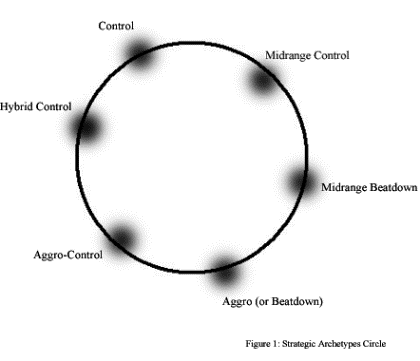
The two “baseline” strategies can be thought of as “Control” and “Aggro” (or beatdown, if you prefer, but that gets confusing for reasons we’ll get to in a moment). The lines between the archetypes are deeply fuzzy, though. Control decks can generally be said to attempt to enter a late game and dominate from that point in the game. Aggro decks can generally be said to wish to avoid a late game, and dominate the early game. On the left side, the Hybrid Control decks (like Faeries or Vintage Oath) and Aggro-Control decks (like Merfolk or U/G Madness) generally try to hold temporal advantage while applying varying levels of aggression. On the right side, the Midrange decks generally attempt to maximize board advantage while applying varying levels of aggression.
A Midrange deck is best defined as this:
Midrange decks generally attempt to dominate the board and maximize use of cards that will be relevant in every stage of the game.
Like any archetype, whether they succeed in this attempt or not is often a function of card availability and metagame issues. Take our poor, beleaguered “pure” control deck, for example: it doesn’t have the cards to really exist in the way that someone like me or Gerry Thompson might want it to. We have to play finishers, damnit, and that sucks!
The question of relevance is a real key for Midrange. This obsession with maximizing relevance in numerous stages of the game is exemplified by a card like Kitchen Finks. Kitchen Finks can supply beatdown against a more controlling deck, or suppress beatdown from a more aggressive one.
Perhaps the biggest godsend to a certain era of Midrange deck is a constant fixture in nearly every format it is legal, the Tarmogoyf. It behaves exactly as the Kitchen Finks does, above, but is capable of being very, very aggressive.
Take this example that uses both cards, from Grand Prix: Los Angeles:


Creatures (8)
Lands (26)
Spells (26)
- 3 Umezawa's Jitte
- 4 Darkblast
- 4 Life from the Loam
- 3 Putrefy
- 2 Slaughter Pact
- 3 Thoughtseize
- 3 Bitterblossom
- 3 Raven's Crime
- 1 Worm Harvest
Sideboard
Michael Jacob list is a classic Midrange deck. It is slow enough (and built to be) that it begins to move into the Midrange Control portion of the archetype. You can take step-by-step changes to the deck to slowly move it further in that direction, or you can give it nudges to move it into a more aggressive deck as well.
This is a far cry from an old classic Midrange Beatdown deck. PT Junk is a great example of this from my own deckbuilding history:
PT Junk — Adrian Sullivan, circa 2000
4 Duress
3 Skyshroud Elite
2 Powder Keg
3 Cursed Scroll
4 Phyrexian Negator
4 Blastoderm
4 River Boa
3 Seal of Cleansing
3 Demonic Consultation
3 Swords to Plowshares
4 Tithe
3 Mox Diamond
2 Grassland
4 Wasteland
4 Treetop Village
4 Scrubland[/author]“][author name="Scrubland"]Scrubland[/author]
3 Bayou
3 Savannah
Sideboard:
3 Massacre
3 Perish
3 Ebony Charm
3 Wax / Wane
3 Choke
This is a deck that even Kai Budde conceded beat Trix back in the day. Where Jacob’s list spends more time destroying the board, this deck spends more time establishing it. Either way they tend to play out the same: versus controlling decks they beatdown, versus aggressive decks, they control.
Why Different Strategies is Not Unfocused
In the attempt to be maximally relevant, creatures, especially big creatures, are often a huge part of the archetype. Some creatures aren’t actually big but they act as big pseudo-creatures.
A great example of this is in Boat Brew.
Siege-Gang Commander
Ranger of Eos
Reveillark
Figure of Destiny
Siege-Gang is a 2/2 for 5, but it can also be conceived of as a 5/5 for 5 (at least).
Ranger of Eos is a 3/2 for 4, but it can also be conceived of as a 5/4 for 6 (at least).
Reveillark is a 4/3 for 5, but often ends up being, essentially, a 8/7 for 5 (with a wee bit of time).
What these cards supply Boat Brew is the flexibility to be successful as either a more controlling or a more aggressive deck, depending on its needs. It’s not that the deck is hoping to be able to be both, it is that the cards allow it the option, depending on need. It isn’t being schizophrenic. The cards just happen to work out such that it is able to fulfill either role well.
This isn’t always the case. Typically, in fact, attempt to do both things merely makes you bad at both. The power of various strategic archetypes ebb and flow, though, with the metagame and with card availability
A big part of what is happening for these decks in why they perform in these ways is expressed by remembering some lessons from Mike Flores seminal work, “Who’s the Beatdown?” Every matchup is about positioning. Even when you place two decks against each other that are nominally Aggro- decks, one of them will be the Control deck in the matchup, role-wise. Hatred can hardly be considered a Control deck, but in the face of opposing Red decks, it often gets forced into being the Control deck (and it is bad at it). Red Aggro on Red Aggro, it doesn’t matter; someone is the control player.
For a Midrange deck of either variety, this means that against Aggro decks they will typically take the Control role, even if their strategic archetype isn’t “Control.” This means that against actual Control decks, they will take the Beatdown role, even if their strategic archetype isn’t Aggro.
A part of what makes this so confusing is the language inconveniently uses the same terms. Let’s review, for clarity:
Strategic Roles (from Who’s the Beatdown):
– Control (generally the person with inevitability)
– Beatdown (generally the person with more threats)
In every matchup, at least one deck is the Control deck and at least one deck is the Beatdown deck (very rarely, this is the same deck, and woe be to you’re the role-less deck).
Strategic Archetypes
– Control
– Midrange Control
– Midrange Aggro (or Beatdown)
– Aggro (or Beatdown)
– Aggro-Control
– Hybrid Control
These archetypes completely bleed into each other. The center of these strategic archetypes is easily identifiable, but because of card choices, decks of any of these archetypes can behave, if only briefly, like decks of other strategic archetypes for a
Take the following examples of various B/W decks as they traverse the wheel, from this current PTQ season:
Creatures (21)
- 2 Burrenton Forge-Tender
- 3 Cloudgoat Ranger
- 4 Goldmeadow Stalwart
- 4 Knight of Meadowgrain
- 4 Wizened Cenn
- 4 Figure of Destiny
Planeswalkers (3)
Lands (25)
Spells (11)
Miles Rodriguez’s deck is clearly an Aggro deck. Its active mana curve is quite low (adding in reactive cards in the parenthesis):
1CC: 10 (13)
2CC: 8 (12)
3CC: 4
4CC: 3
5CC: 3
But, if you wanted to, you could traverse a little bit counterclockwise on the Strategic Archetype circle, and have a deck that has moved into Midrange, albeit Midrange Beatdown.
Creatures (16)
Planeswalkers (3)
Lands (24)
Spells (17)
Sideboard
Dallas winner Mandee Peralta’s deck is clearly not an Aggro deck, if you look at its curve. Don’t be fooled into thinking that just because it has the ability to attack, and do it well, it is a pure Aggro deck. Check this out:
1CC: 0 (3)
2CC: 12 (15)
3CC: 10
4CC: 5
5CC: 3
This deck is fully capable of putting on a clock, but for that matter so is a deck like Aggro-Loam. But it is clearly far more concerned with establishing a board presence. It will feel more comfortable getting into a late game, by far. It includes a ton of cards that are intended to be relevant at multiple stages in the game besides just the initial portion of it. Where a Spectral Procession in the other deck can be a last desperate grab for the game in the late-game, in this deck, with Anthems and Ajanis, it can be a frightening threat.
Compare that to Richmond finalist Calloso Fuentes, who steps even further around the curve:
Creatures (15)
Lands (23)
Spells (22)
1CC: 0 (2)
2CC: 8
3CC: 12
4CC: 7 (9)
5CC: 3
He’s definitely moved many steps away from Aggro, and is now firmly on the border of Midrange Control, if not fully in it. If you were to go even further down this path, you’d eventually have a bona fida control deck. (That said, I don’t recommend it; just because you can build a deck, it doesn’t mean it will be any good.)
The other PTQ winner with B/W tokens is somewhere in between Calloso and Mandee.
Creatures (15)
Lands (23)
Spells (22)
1CC: 0 (3)
2CC: 8 (10)
3CC: 12
4CC: 7
5CC: 3
However far we step around the curve in either direction, there is nothing stopping us from doing so. It doesn’t mean, however, that the deck being moved into a new position will be any good. Sometimes it can actually be hard to tell where exactly we are, strategic archetype-wise — is Jacob’s Aggro-Loam a Midrange Control deck (I think so) or a Midrange Beatdown deck? It’s on that edge. At other times, it is abundantly clear, as in the case for Rodriguez’s deck. Cards like Ranger of Eos are incredibly good at blurring the line between Aggro and Midrange portions of strategic archetypes.
It is perhaps best captured in this Modified Strategic Archetype Circle:
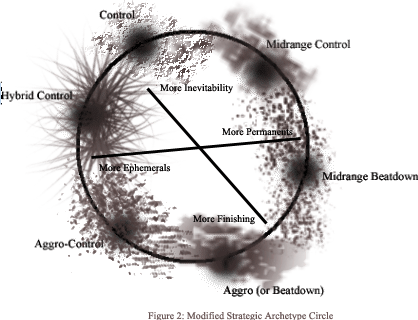
The goodness or badness of any deck is not at all related to where it sits on the circle. Goodness or badness is measured in a deck’s fitness with regards to the current metagame, and its overall strength on its own merit. The difficulty lies in the ease of deck is not at all related to where it sits on the circle. Goodness or badness is measured in a deck’s fitness with regards to the current metagame, and its overall strength on its own merit.
The difficulty lies in the ease of trying to create good decks that are in the less common archetypes. Most of the time, when we build a deck that is “between” aggro and control, we’re building a Midrange deck, and the combination of cards are just unexciting. Other times, we get Ghazi-Glare or B/W Tokens, because the cards are simply there. Aggro-Control is also rare, simply because it is hard to have the combination of fast board position and ephemerals used for tempo control actually come together into something cohesive and good. Hybrid-Control is probably the rarest of all, simply because it is so rare for a deck to actually actively take shifts from the control role into an aggro-control role (the only archetypes that replay this strategic moment again and again that come to mind are Standard/Block Faeries, Accelerated Blue, and Vintage Oath).
Because we are so often accustomed to seeing only “pure” aggro and control decks winning, we sometime can fool ourselves into thinking they are better, archetypically. This is not the case. What is the case is that the philosophies that are in Wizards R&D are lending themselves to cards that tend to make these decks good. Conversely, there aren’t many cards that happen to lend themselves to these rarer archetypes. This doesn’t mean those archetypes are no good. It simply means that it is less likely that a deck will exist in the archetype and be good.
With all of this Black/White running around, I thought I’d share my own version of the deck, which definitely fits closer into the Midrange Aggro side.
Creatures (14)
Lands (22)
Spells (24)
- 3 Plains
- 3 Glorious Anthem
- 3 Ajani Goldmane
- 4 Bitterblossom
- 4 Spectral Procession
- 3 Path to Exile
- 4 Zealous Persecution
Sideboard
This is very nearly Mandee Peralta’s winning list of Black/White. In this metagame, I feel that playing Zealous Persecution at a four-count is imperative. At the same time, I feel like I want the deck to be able to just start beating as often as possible, and so I’ve found room by cutting the Flitters for that 4th Persecution and another Mutavault. My board is nearly the same as his, as well, with Mark to knock down burn spells, Wispmare to help fight the mirror, Identity Crisis and Thoughtseize to attack the hand, and Wrath of God to clean up any unhappy messes. Celestial Purge fits in as a way to tackle Anathemancer, and I’ve cut a single Mark to make room for one.
Overall, when it comes to thinking about the strategic archetypes and Midrange, it simply isn’t useful to set up the archetype as a Straw Man. Real decks exist that are clearly good that fit within the auspices of Midrange. Conflating a weakness of the strategic archetype with a weakness of bad decks that aren’t right for the moment in history won’t get you as far as understanding what the archetypes are, why they work (when they do), and pretending your deck is of a different archetype. Doing so merely robs yourself of the ability to understand your own position in complex metagames, and damns you into failing to build sideboards properly and play out matchups optimally (see Worlds 2008 for abundant examples of people doing this with Black/White Tokens).
See you at Regionals!