
Try and think of a deck that only needs one land in play to win the game by dealing twenty damage to its opponent. Got it? What if that land was Bazaar of Baghdad?
Take a look at this:


Creatures (21)
Lands (13)
Spells (26)
- 4 Brainstorm
- 1 Vampiric Tutor
- 1 Time Walk
- 1 Ancestral Recall
- 1 Imperial Seal
- 4 Careful Study
- 4 Cabal Therapy
- 1 Crop Rotation
- 1 Black Lotus
- 1 Lotus Petal
- 1 Mox Jet
- 1 Mox Sapphire
- 4 Chalice of the Void
- 1 Chrome Mox
Sideboard
I know I’m far from the first person to show you this deck concept. If you are an exclusively Vintage player and haven’t seen this deck in Extended, you probably have seen some people attempting this deck in one lame variant or another.
However, I’m the first person to make this deck good in Vintage. I’m proud of this deck for a number of reasons. It breaks all the rules. First of all, it’s an aggro deck. Aside from Workshops, let’s be honest, Aggro hasn’t seen the light of day in Vintage in a decade. Second, it breaks through all of the constraints of the format.
Countermagic? I could care less.
Trinisphere? Cool, I’ll win now.
Third, this deck has the honorable and notable distinction of being the first deck in the history of Magic whose game plan does not rely in even a small measure on playing spells. Former Meandecker and Dutch prodigy Arthur Tindemans built a deck a couple of years ago playing forty lands with four Trinisphere and four Crucible of Worlds. That deck obviously could win with just lands, but it relied on playing spells. Worldgorger Dragon combo only needs two mana, a Bazaar, and an Animate Dead to win, but it still requires a spell to be played. Â
Not so with this deck. You will play spells because you can, but not because you have to. All you need is a Bazaar of Baghdad to win the game. Â
If that wasn’t enough to just make you want to play this deck for the cool factor, I’m here to announce that this deck is actually savage. This deck has a turn 3 and 4 goldfish that can’t be stopped by countermagic or mana denial, the two dominant strategies in Vintage. The only way to beat it is to win first using a faster combo, or use cards like Tormod’s Crypt, or slow it with Pithing Needle. If you can swing with two Ichorids on turn 2 or an Ichorid and an Ashen Ghoul or two Ashen Ghouls on turn 3, then you can win on turn 3. Otherwise, you are aiming for turn 4.
That’s okay. We have disruption.
In this article, I’m going to briefly present this deck, explain some of the important design aspects of the deck, and then wrap up until next week. I have been working on this deck for StarCityGames.com Richmond double Power Nine tournament (which, as of this writing, will occur this weekend) [Of course, it has now occurred… and Stephen did quite well. — Craig]. Because of this deck’s trickier matchups, I have had to devote all of my free time to testing it (and work and sleep consuming the rest). Thus, writing an article on the deck was obviously at the bottom of my priorities. But I wanted to get this out there as promised. Importantly, my perception of the deck will clearly be different after my tournament experience.
Friggorid is a brilliant concept. So, in a sentence, what is this concept? Dump your library into your graveyard as quickly as possible and swing in with Ichorids and Ashen Ghouls.
It’s one of those combos so perfect and elegant that we can be assured that no designer within the confines of R&D would have let it slip by. Its inadvertent nature is part of what makes it so beautiful – much like Illusions Donate or the Doomsday Mind’s Desire plus Beacon of Destruction combo (the most elegant win condition ever conceived).
Every deck has to face the necessity of playing spells, combating countermagic (particularly the power of Force of Will and Mana Drain) and survive the horrific beating of mana denial (Null Rod, Wastelands, Crucible plus Strip Mine recursion, Trinisphere, Smokestack, etc). This deck cares about none of those things. Add to that a turn 3.5 goldfish, and you have one of the best Vintage decks.
This card is the heart and soul of the deck. For years, Bazaar of Baghdad languished in obscurity. The earliest uses of Bazaar can be found in the infamous Maysonet Rack-Balance deck. This was the old four Balance deck that so many old-timers reminisce with fear and loathing. A few years ago, a number of Vintage players in Europe incorporated Bazaar of Baghdad into their control decks as a draw engine with Squee, Goblin Nabob. As Wizards has come to print more and more mechanics over the last few blocks, Bazaar of Baghdad has seen its stock rise dramatically. The printing of Worldgorger Dragon made the card a Vintage staple, but the threshold, madness, and flashback mechanics all presented strong uses of Bazaar of Baghdad. Robert Vroman found great utility is pairing Bazaar with the insufferable Uba Mask to generate enormous card advantage without having to discard to the Bazaar. Some other players have used Bazaar to play “Teen Titans” — a Goblin Welder Reanimator deck focusing on cards like Sundering Titan. Then Wizards made Dredge and we have yet another abusive use of Bazaar.
Bazaar is crucial in this deck for two reasons. First, it permits you to use the dredge mechanic. A discard outlet is critical; otherwise you have no way to begin dredging. This is a discard outlet extraordinaire. It has no mana cost, it can’t be countered, and it digs into your deck at the same time it drops three cards into your graveyard. The second reason it is so crucial is because dredge requires that you substitute a draw in order to activate the dredge mechanic. Thus, Bazaar is doubly broken — a perfect fit. You can discard and then draw. So for example:
Turn 1:
Bazaar. Activate it. Discard Golgari Grave Troll, Stinkweed Imp, and Ichorid.
Turn 2:
On your upkeep, activate Bazaar. Dredge for at least eleven. Discard the Troll, Imp, and another Dredge card. You can also put the Ichorid into play this turn. Then on your Draw Step you can dredge again. Hopefully, you’ll have seen at least one Cabal Therapy in all of those cards.
Now you see why Bazaar is so busted.  That’s the reason this deck has Imperial Seal (which, by the way, is busted with Bazaar). With Imperial Seal, you can play it on your main phase, then Bazaar.
Now, there is a flaw. Pithing Needle, already seeing a good measure of success, will undoubtedly see an increase in usage to fight this monster deck. Thus, the inclusion of Brainstorm.
Brainstorm is the second best unrestricted card in the deck, after Bazaar.
Brainstorm would generally seem to be a natural inclusion in any deck with a light mana base, fetchlands, and tutors. Brainstorm optimizes quite a bit in this format where drawback is quite minimal. Brainstorm is clearly the second best “U” casting cost spell ever printed. The problem is that Brainstorm seems counterintuitive in this deck. Why play a card that makes you put cards on top of your library?Â
The reason is this: Brainstorm says “draw three cards” on it. That’s it. So as long as you were able to discard a single dredge card, you can use Brainstorm to dredge three times for upwards of eighteen cards. True, you will have to put two dredge cards on the top of your deck – but that can actually be a benefit. If you Dredge again on your next draw step, you’ll automatically dump those other dredge cards into the bin.Â
Thus, you could get a hand that has: Careful Study, Brainstorm, land, and four other cards… and be quite fine. You can dredge half your deck on turn 2 and not have to rely on Bazaar. So Brainstorm is here simply so that it helps you deal with not having Bazaar. However, the fact that it does optimize your hand early on, can dig for disruption, and set up a perfect hand is certainly another reason that it’s been included.Â
Here is an actual play I did in a game:
Turn 1:
Bazaar of Baghdad discarding Troll, Imp, and Ichorid.
Turn 2:
Upkeep: activate Bazaar to dredge the Troll and the Imp, discarding them.Â
Draw Step: dredge the Troll.
Main phase: Play Underground Sea and Brainstorm: dredge two Trolls and an Imp.
That’s a total of thirty-four cards on turn 2 alone.Â
The Mana
I was working on this deck and I had a realization. Most of the decks that people had come up with had upwards of twelve or thirteen non-Bazaar lands in the deck. I realized something: this deck reminded me of Gro. Upon that realization, I was able to make the first real design leap.
Some time ago, Alan Comer created a deck called TurboXerox – the predecessor to a deck you all may better know as Gro.
The Gro concept is simple: if you build a deck around a whole bunch of cantrips, you can run less mana. For every two cantrips, you can cut a mana source, approximately. I ran into Pat Chapin in 2002 and he was playing a Vintage Gro deck with this mana base:
4 Land Grant (remember, Fetchlands didn’t exist then)
4 Tropical Island
4 Island
1 Library of Alexandria
1 Mox Sapphire
1 Mox Emerald
1 Black Lotus
When Fetchlands were printed, it made possible the ultimate deck: GroAtog:
4 Underground Sea
4 Tropical Island
5 Fetchlands: Polluted Delta/ Flooded Strand
1 Library of Alexandria
1 Mox Sapphire
1 Mox Jet
1 Mox Emerald
1 Black Lotus
GroAtog had an absurdly light mana base. Meandeck Friggorid has an even more absurd mana base because you don’t need mana at all. No need to cast silly Quirion Dryad in this deck! Moreover, I am running a whole swath of one-mana cantrips – the best in the format.
Thus, this deck has a mana base of:
8 mana producing land
4 Bazaar of Baghdad
1 Strip Mine
1 Mox Jet
1 Mox Sapphire
1 Black Lotus
1 Lotus Petal
1 Chrome Mox
Until the last minute, I was running this land configuration almost entirely to support a maindeck Wonder:
4 Underground Sea
2 Polluted Delta
2 Watery Grave
Chrome Mox earned its inclusion because of one reason: It helps you reanimate Ashen Ghoul faster and thus win sooner. Strip Mine isn’t really a land, so much as it is a spell.
I tested the five-color mana base (which supports Crop Rotation) and found that the Gemstone Mine was never problematic — even when reanimating Ashen Ghoul.
As a person who is obsessed with design possibilities in Vintage, I can tell you positively that Careful Study makes me excited. I am obsessed with casting costs and I pay very close attention to all spells that have the following casting cost:
0
1
U
B
In terms of “U” there are a few really busted cards with Ancestral Recall leading the pack and Brainstorm right behind. I used Sleight of Hand in Meandeck Tendrils, but Careful Study is probably in the top 5 best “U” casting cost cards in Magic, period. Chain of Vapor and Mystical Tutor probably round out the top 5 – sorry High Tide.
None of you probably remember this, but way back in 2003, some Germans – I think it was Roland Bode – came up with a sweet Careful Study concoction using Roar of the Wurm, Rootwalla, and an insanely amazing efficient deck. That deck really alerted me to the power of Careful Study. The problem is that despite Careful Study’s absurd objective power, it is simply too conditional to be in most decks. I couldn’t be more pleased to be abusing it in the grossest manner imaginable.
Turn 1 Careful Study discarding two dredge cards not only gets some dredge in your yard, but it completely optimizes your hand. You may draw a busted spell, see a Chalice, or find a Bazaar. Either way, you’ll be able to dredge multiple times next turn, either off a Brainstorm, another Careful Study, or Bazaar.
Important Rules Notes
I’m going to explain some rules things about this deck.
First of all, Ichorid triggers on your upkeep no matter what. Thus, if you go like this:
Turn 1:
Bazaar. Activate it, discarding Ichorid, Troll, and Cabal Therapy.
Turn 2:
Put Ichorid trigger on the stack. Upkeep, activate Bazaar dredging Troll and putting Putrid Imp into your graveyard, among other cards.
You can then remove the Imp to put the Ichorid into play.
Second, Ashen Ghoul is an activated ability. Thus you could play it like this:
Turn 1:
Bazaar, use it, discarding double Troll and a Therapy. Play Mox Jet.
Turn 2:
Upkeep, activate Bazaar seeing Ashen Ghoul. (Note: you also control which order the creatures fall into the graveyard). Thus you put the Ashen Ghoul you revealed in the first dredge into your graveyard first. Stack three creatures on top of him, and then tap the Jet to put him into play.
Third, dredge works like this:
Turn 1:
Bazaar. Activate it, discarding Ichorid, Troll, and Cabal Therapy.
Turn 2:
Upkeep, activate Bazaar dredging the Troll. In your dredge, you see Stinkweed Imp. For your second card draw for Bazaar, you may dredge the Imp you just revealed.
Thus, when you play a card like Brainstorm, you really go busted… like this:
Turn 1:
Land, Careful Study discarding Troll and Ichorid
Turn 2:
Upkeep, Brainstorm dredging the Troll revealing another Troll in that dredge. Dredge the second troll for the second Brainstorm draw. You see an Imp in that second dredge. Dredge the Imp for your third Brainstorm draw. Thus, you just dredged seventeen cards using Brainstorm alone.
Time Walking
Every deck in Vintage is really tempo oriented at the moment. There are so many tutors that almost every deck in the format was designed to find and resolve Yawgmoth’s Will or lock you out of the game. If you could get a slight early game advantage, you could protect and ride out a Yawgmoth’s Will, or Tinker for Darksteel Colossus.Â
How do you get Time Walks with a deck like this? People on my team did not seem too surprised that I cut half the mana out of the deck upon the realization that this was actually a Gro deck. However, they did quiz me about why I included Strip Mine.
Originally, the list I started with had four Wasteland. The theory is simple: Wasteland in an aggressive deck is a huge tempo boost. Consider the two plays below:
A. The TnT Wasteland
Turn 1:
Mishra’s Workshop, Mox Emerald, Juggernaut.
Your opponent:
Tundra
Turn 2:
Wasteland the Tundra. Attack with Juggernaut.
Your opponent:
Island
What just happened? That Wasteland rewound the game a turn. Unfortunately for your opponent, they are one turn closer to death from Juggernaut. Wasteland here was a Time Walk. This is how Wasteland can be used as a tempo boost.Â
Here is another completely different use of Wasteland.
B. The 4CC Wasteland
You are playing Control.
Your opponent:
Mishra’s Workshop, Mox Emerald, Juggernaut
You:
Wasteland the Mishra’s Workshop.
Now, what happened here? Here, you used Wasteland to deny your opponent mana – to try and cut them off from playing spells. But what you have actually done is rewound the game a turn and given your opponent an extra swing of their creature, putting you a turn closer to death.
In an aggro deck, Wasteland cannot be a tempo loss or tempo neutral. It has to be tempo boosting.Â
I had Wasteland in here until I realized that the only relevant matchup for this deck: Control, doesn’t really care about Wasteland. Stax can’t beat this, and neither will Fish.
However, Strip Mine is incredibly savage. Strip Mine is really random in a deck like Control Slaver or Gifts. I know why people like Ben Kowal play it – it’s because if you are ahead it can be a huge tempo boost. People will sometimes just lose to it because they only see one Island, and rely on the Island since almost nothing kills Island besides Strip Mine… and they walk right into it. However, Strip Mine in Gifts isn’t even one-tenth as powerful as Strip Mine in this deck.Â
Imagine:
Turn 1:
Bazaar of Baghdad. Use it discarding Golgari Grave Troll, Stinkweed Imp, Ichorid.Â
Your opponent:
Island, go.
Turn 2:
On your upkeep, activate Bazaar and dredge the Troll, and then dredge the Imp and discard three cards. Put Ichorid into play. Play Strip Mine and Strip your opponent.
You just won the game. This deck goldfishes on turn 3 and 4. The Strip Mine play has just sealed this game up. There is almost nothing that your opponent can now do. Tinker for Darksteel Colossus is too slow.
Chalice of the Void has many characteristics of Strip Mine. It also has additional tactical benefits that go beyond mana denial. Turn 1 Chalice for zero will not only slow an opponent down, it can shut them out.
Consider…
Here is a hand that Grim Long might have:
Gemstone Mine,
Black Lotus,
Mox Ruby,
Dark Ritual,
Brainstorm,
Grim Tutor,
Wheel of Fortune.
Now, Chalice here hasn’t killed the Grim Long player if it comes down before Long gets a turn, but what it has done is buy you enough time to win the game before they can combo out.Â
Consider this…
Turn 1:
You: Bazaar of Baghdad. Activate it and discard Cabal Therapy, Troll, and Ichorid. You drew Chalice of the Void, and played it for zero.
Grim Long: Gemstone Mine. They Brainstorm.
Turn 2:
You: On your upkeep, let the Ichorid Trigger go on the stack and tap the Bazaar. Dredge the Troll, revealing another dredge card. Dredge that, and then discard some creatures. Remove a Black creature to put the Ichorid into play. Then use your draw step to dredge. Attack with Ichorid and then flashback Cabal Therapy, naming a card they run as a four-of. Since they already played Brainstorm, you name Dark Ritual, and snag it.Â
Grim Long: They play another land and pass, since you took their Dark Ritual.Â
Turn 3:
This time you bring in the rest of your Ichorids, and Cabal Therapy them twice. The Grim Long player is now shut out of the game, and you win on turn 4.
That’s how you want Chalice to work. Sure, your opponent could have kept this hand:
Mox Sapphire,
Black Lotus,
Lotus Petal,
Mana Vault,
Ancestral Recall,
Gifts Ungiven,
Mana Drain.
The reality is that this kind of hand is unlikely. You use Chalice because it buys you time to get your discard online, and so that you can win before they can combo out.
Here is another practical use of Chalice. Your opponent’s hand is:
Polluted Delta,
Volcanic Island,
Mystical Tutor,
Mox Emerald,
Thirst for Knowledge,
Mana Drain,
Brainstorm.
Your Chalice has not just prevented them from playing the Mox Emerald so that they can’t Thirst on turn 2, but you’ve had two key tactical benefits as well:
a) They can’t Mystical Tutor for Tinker, and use Tinker.
b) They can’t use Welder right now, because they’ll have to find Sol Ring or Mana Vault in order to weld something back in.Â
The trickiest card to use in the whole deck is Cabal Therapy. This is one of the most skill intensive cards ever printed (I love it). It involves bluffs, tells, signals, and format knowledge. It is as hard to play against as it is to play properly, and is the one card that opens the game up most to skill leverage in a deck that really doesn’t do that enough.
As a general rule, if you are casting turn 1 Therapy blind against a control deck, you name Brainstorm. If it is past turn 1, you name Thirst for Knowledge against Control Slaver and Gifts. If you are going to win next turn, you name Yawgmoth’s Will. It is important to Therapy your opponent as soon as you can. If you don’t use all four Therapies every game you win, you are not playing it correctly.
The Tutors
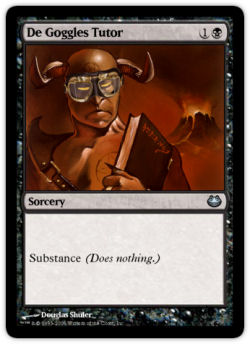
Demonic Tutor was in this deck for some time until we all agreed it was ze goggles (zey do nothing!). The best card to Demonic Tutor for is Time Walk, and the act of Tutoring for Time Walk just gave your opponent the Time Walk. Vampiric Tutor and Imperial Seal are crucial, because they permit you to turn one Tutor up Bazaar. Crop Rotation does the same thing. Thus, they make terrible hands keepable.
Putrid Imp replaced Psychatog (and Unearth up Psychatog)
He does most of what you want Psychatog to do. He is a 2/2 flyer that can be sacrificed to Cabal Therapy and that enables you to keep hands without Bazaar of Baghdad, making this deck even more consistent.
So, what did I not include?
Tolarian Winds was the big lure that people designing this deck fell for. Tolarian Winds is amazing — no doubt about it. It is simply too slow. To support Winds you have to increase your mana count in some manner, generally by playing with at least three more off-color Moxen. They clog the deck and make it wretched. Winds is sweet on paper, but when you see how my deck operates, you’ll see it’s the wrong way to go. It makes this deck not a Gro deck, but something much worse.
I entertained a million different options, from Gamble to Unmask to Filth. Anything you suggest, I’m fairly certain I’ve tried it. What you see here is the product of several weeks of intensive testing with the whole brain trust of Team Meandeck on the job.
This decks trickiest matchup is the one I’ve been spending the most time on: Brassman Gifts, followed by Control Slaver. I’m going to reserve the analysis of those matchups for my next article. Generally speaking, this deck smashes Stax and Fish and splits with Brassman Gifts and Control Slaver. It splits with Combo, but smashes Oath.
Pay attention to the Mana Drain and you’ll find out how I do!